Supabase is one of the most user-friendly PostgreSQL development platforms, and we can easily create a database based on their free plan. Actually, they didn’t modify the core Postgres source code, but they actually give a complete backend that can be used to improve the functionality of postgresql. Recently, we researched the Supabase platform, and we found some useful extensions used by Supabase.
If you have already tried Supabase, then just go to the extensions page, and you can see the list of extensions used by Supabase.
We can easily create or drop this extension from our database by just clicking the button in the Enable column in the image below
Here, we can see each extension name, its version, schema, description, the use of this extension, a link for more information about that extension, and also the creation button.
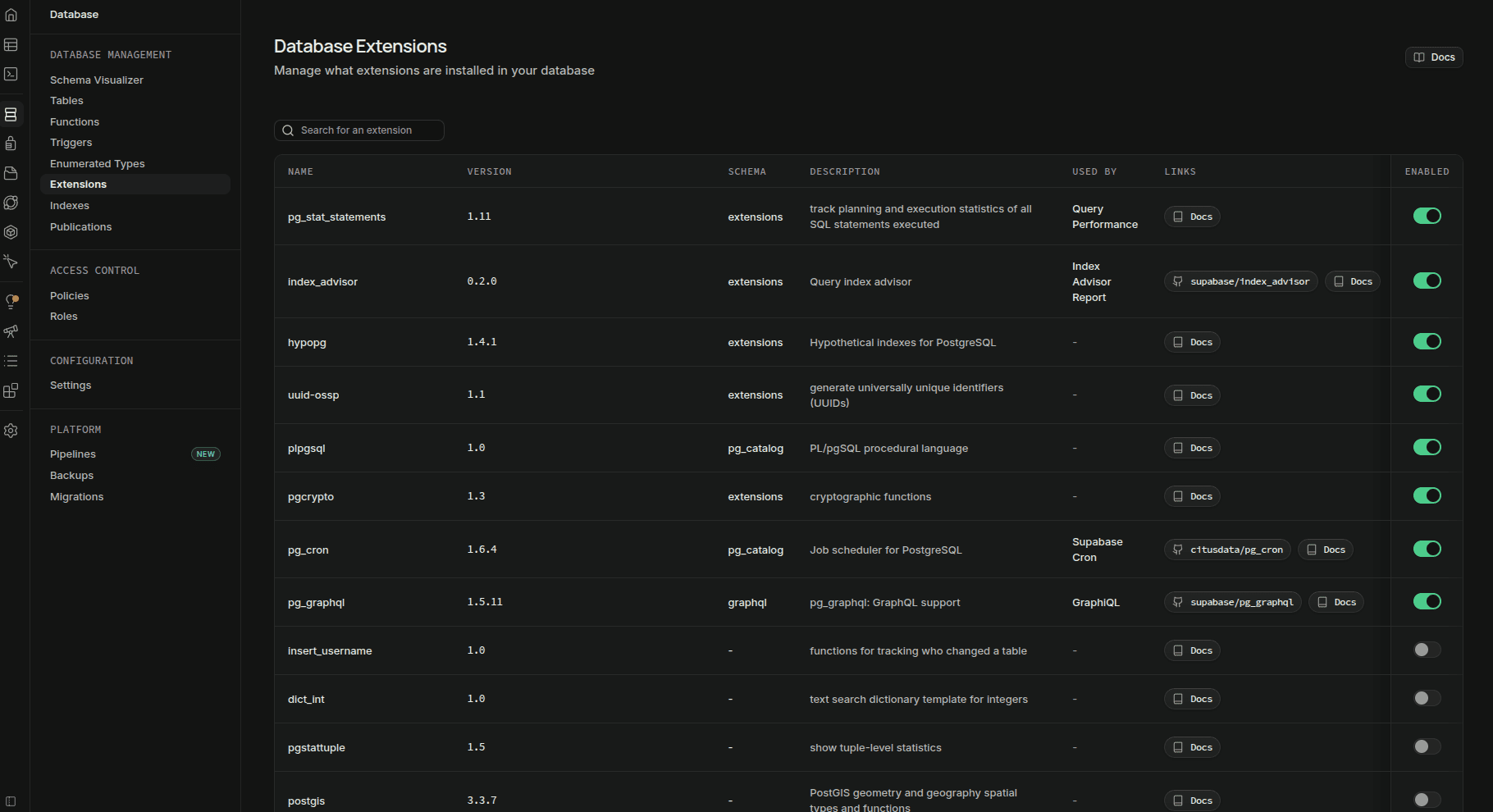
Supabase has additional extensions that should enhance the functionalities of postgres database.
In Supabase, there is also a way to run queries on our database. So, we can use this query to see all the extensions that can be installed in our database.
Now, execute this query in the normal psql terminal of postgres version 17.
select * from pg_available_extensions;
Result:
        name        | default_version | installed_version |                                comment
--------------------+-----------------+-------------------+------------------------------------------------------------------------
 pg_walinspect      | 1.1             | 1.1               | functions to inspect contents of PostgreSQL Write-Ahead Log
 pg_visibility      | 1.2             | 1.2               | examine the visibility map (VM) and page-level visibility info
 pgstattuple        | 1.5             | 1.5               | show tuple-level statistics
 seg                | 1.4             | 1.4               | data type for representing line segments or floating-point intervals
 pageinspect        | 1.12            | 1.12              | inspect the contents of database pages at a low level
 btree_gist         | 1.7             | 1.7               | support for indexing common datatypes in GiST
 postgres_fdw       | 1.1             | 1.1               | foreign-data wrapper for remote PostgreSQL servers
 intarray           | 1.5             | 1.5               | functions, operators, and index support for 1-D arrays of integers
 sslinfo            | 1.2             | 1.2               | information about SSL certificates
 earthdistance      | 1.2             | 1.2               | calculate great-circle distances on the surface of the Earth
 ltree              | 1.3             | 1.3               | data type for hierarchical tree-like structures
 file_fdw           | 1.0             | 1.0               | foreign-data wrapper for flat file access
 unaccent           | 1.1             | 1.1               | text search dictionary that removes accents
 pg_trgm            | 1.6             | 1.6               | text similarity measurement and index searching based on trigrams
 cube               | 1.5             | 1.5               | data type for multidimensional cubes
 btree_gin          | 1.3             | 1.3               | support for indexing common datatypes in GIN
 tablefunc          | 1.0             | 1.0               | functions that manipulate whole tables, including crosstab
 tsm_system_rows    | 1.0             | 1.0               | TABLESAMPLE method which accepts number of rows as a limit
 tsm_system_time    | 1.0             | 1.0               | TABLESAMPLE method which accepts time in milliseconds as a limit
 pg_buffercache     | 1.5             | 1.5               | examine the shared buffer cache
 pgcrypto           | 1.3             | 1.3               | cryptographic functions
 pg_stat_statements | 1.11            | 1.11              | track planning and execution statistics of all SQL statements executed
 pg_surgery         | 1.0             | 1.0               | extension to perform surgery on a damaged relation
 intagg             | 1.1             | 1.1               | integer aggregator and enumerator (obsolete)
 pg_prewarm         | 1.2             | 1.2               | prewarm relation data
 dict_xsyn          | 1.0             | 1.0               | text search dictionary template for extended synonym processing
 dblink             | 1.2             | 1.2               | connect to other PostgreSQL databases from within a database
 dict_int           | 1.0             | 1.0               | text search dictionary template for integers
 bloom              | 1.0             | 1.0               | bloom access method - signature file based index
 refint             | 1.0             | 1.0               | functions for implementing referential integrity (obsolete)
 uuid-ossp          | 1.1             | 1.1               | generate universally unique identifiers (UUIDs)
 citext             | 1.6             | 1.6               | data type for case-insensitive character strings
 autoinc            | 1.0             | 1.0               | functions for autoincrementing fields
 insert_username    | 1.0             | 1.0               | functions for tracking who changed a table
 hstore             | 1.8             | 1.8               | data type for storing sets of (key, value) pairs
 pgrowlocks         | 1.2             | 1.2               | show row-level locking information
 isn                | 1.2             | 1.2               | data types for international product numbering standards
 amcheck            | 1.4             | 1.4               | functions for verifying relation integrity
 tcn                | 1.0             | 1.0               | Triggered change notifications
 moddatetime        | 1.0             | 1.0               | functions for tracking last modification time
 fuzzystrmatch      | 1.2             | 1.2               | determine similarities and distance between strings
 lo                 | 1.1             | 1.1               | Large Object maintenance
 plpgsql            | 1.0             | 1.0               | PL/pgSQL procedural language
 xml2               | 1.1             | 1.1               | XPath querying and XSLT
 pg_freespacemap    | 1.2             | 1.2               | examine the free space map (FSM)
(45 rows)
In postgres version 17, there are nearly 45 built-in extensions we can create. Execute the same query in the sql editor of supabase and check the result.
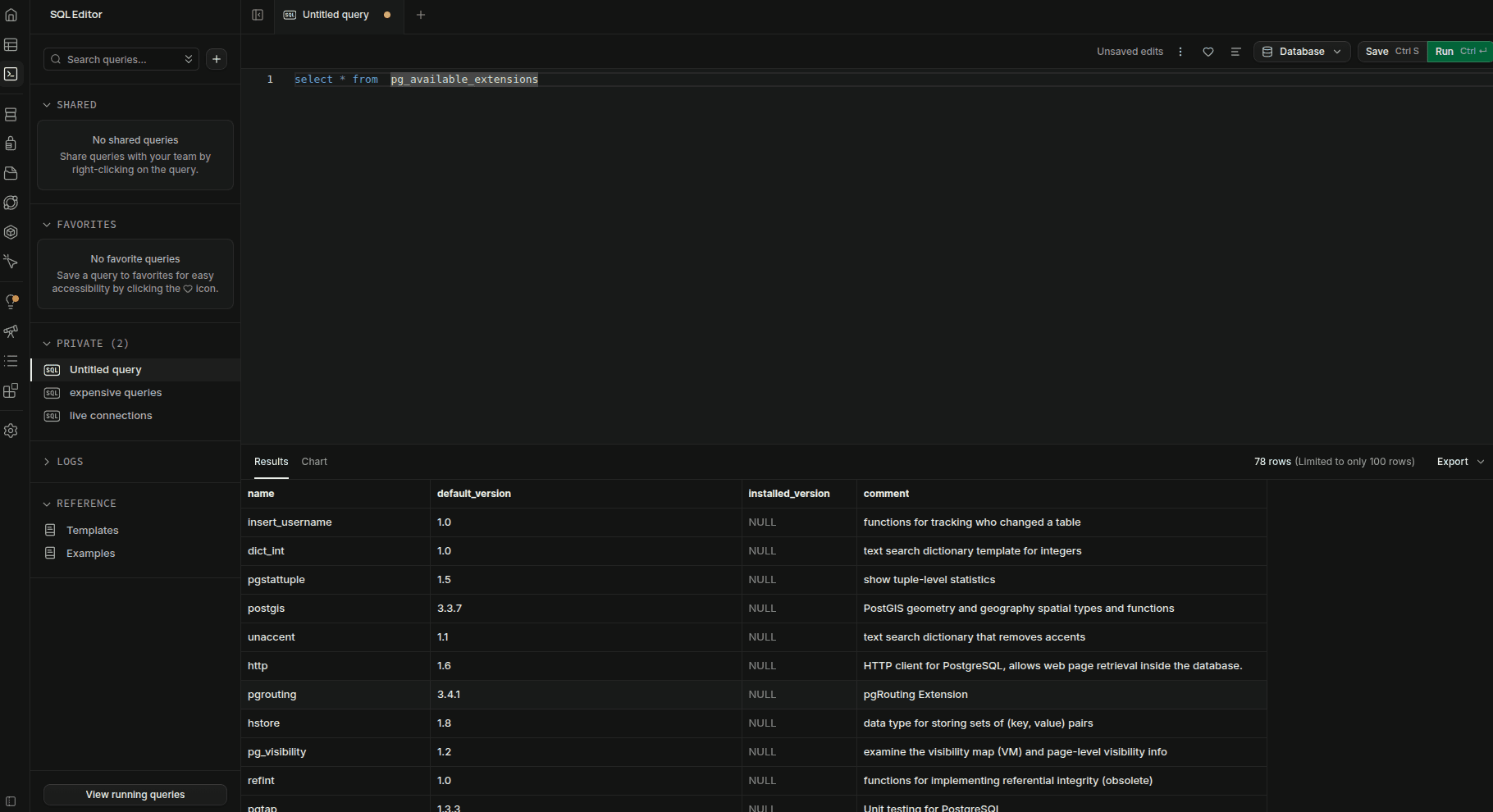
It will show nearly 78 extensions.
On the right side, we have 4 options.
- Copy as markdown
- Copy as json
- Copy as csv
- Download as csv
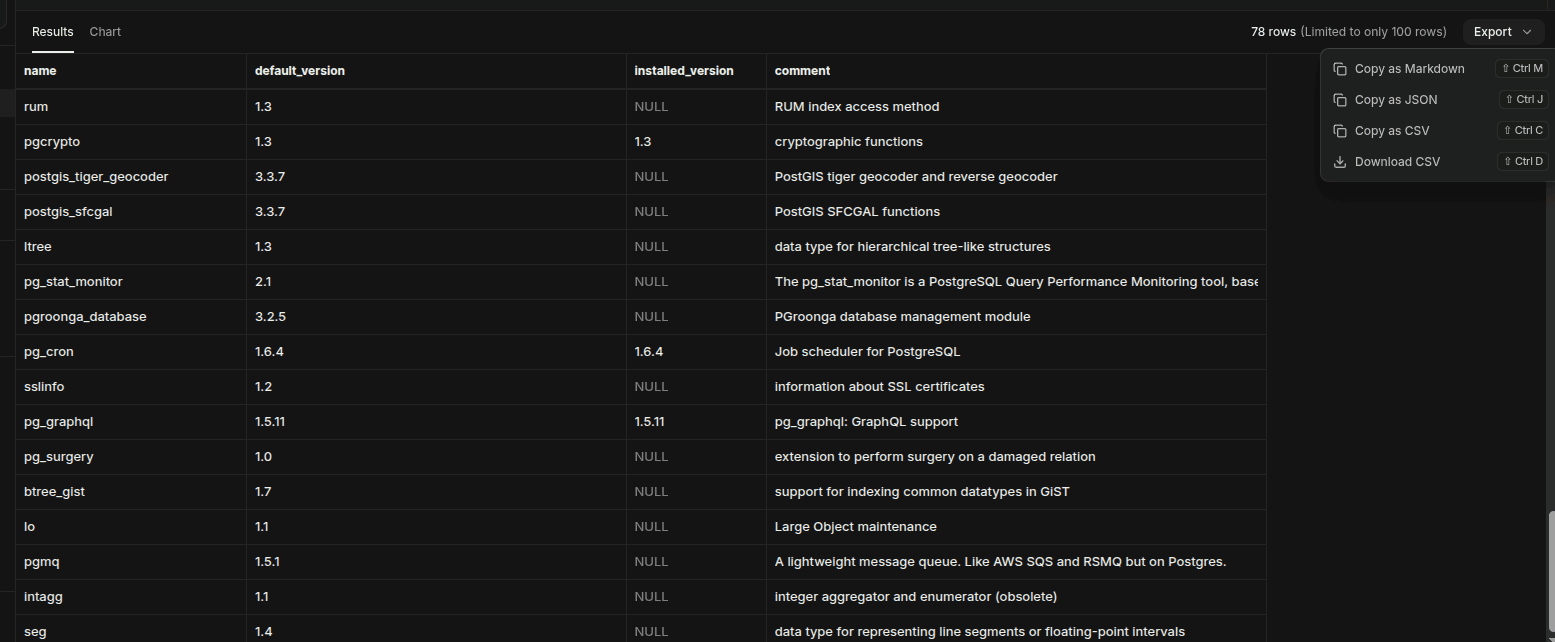
Checking all extensions provided by Supabase and their metadata by copying this complete information into JSON format.
[
  {
    "name": "insert_username",
    "default_version": "1.0",
    "installed_version": null,
    "comment": "functions for tracking who changed a table"
  },
  {
    "name": "dict_int",
    "default_version": "1.0",
    "installed_version": null,
    "comment": "text search dictionary template for integers"
  },
  {
    "name": "pgstattuple",
    "default_version": "1.5",
    "installed_version": null,
    "comment": "show tuple-level statistics"
  },
  {
    "name": "postgis",
    "default_version": "3.3.7",
    "installed_version": null,
    "comment": "PostGIS geometry and geography spatial types and functions"
  },
  {
    "name": "unaccent",
    "default_version": "1.1",
    "installed_version": null,
    "comment": "text search dictionary that removes accents"
  },
  {
    "name": "http",
    "default_version": "1.6",
    "installed_version": null,
    "comment": "HTTP client for PostgreSQL, allows web page retrieval inside the database."
  },
  {
    "name": "pgrouting",
    "default_version": "3.4.1",
    "installed_version": null,
    "comment": "pgRouting Extension"
  },
  {
    "name": "hstore",
    "default_version": "1.8",
    "installed_version": null,
    "comment": "data type for storing sets of (key, value) pairs"
  },
  {
    "name": "pg_visibility",
    "default_version": "1.2",
    "installed_version": null,
    "comment": "examine the visibility map (VM) and page-level visibility info"
  },
  {
    "name": "refint",
    "default_version": "1.0",
    "installed_version": null,
    "comment": "functions for implementing referential integrity (obsolete)"
  },
  {
    "name": "pgtap",
    "default_version": "1.3.3",
    "installed_version": null,
    "comment": "Unit testing for PostgreSQL"
  },
  {
    "name": "address_standardizer",
    "default_version": "3.3.7",
    "installed_version": null,
    "comment": "Used to parse an address into constituent elements. Generally used to support geocoding address normalization step."
  },
  {
    "name": "pg_buffercache",
    "default_version": "1.5",
    "installed_version": null,
    "comment": "examine the shared buffer cache"
  },
  {
    "name": "dblink",
    "default_version": "1.2",
    "installed_version": null,
    "comment": "connect to other PostgreSQL databases from within a database"
  },
  {
    "name": "pgrowlocks",
    "default_version": "1.2",
    "installed_version": null,
    "comment": "show row-level locking information"
  },
  {
    "name": "pg_stat_statements",
    "default_version": "1.11",
    "installed_version": "1.11",
    "comment": "track planning and execution statistics of all SQL statements executed"
  },
  {
    "name": "pg_hashids",
    "default_version": "1.3.0-cd0e1b31d52b394a0df64079406a14a4f7387cd6",
    "installed_version": null,
    "comment": "pg_hashids"
  },
  {
    "name": "index_advisor",
    "default_version": "0.2.0",
    "installed_version": "0.2.0",
    "comment": "Query index advisor"
  },
  {
    "name": "hypopg",
    "default_version": "1.4.1",
    "installed_version": "1.4.1",
    "comment": "Hypothetical indexes for PostgreSQL"
  },
  {
    "name": "pg_partman",
    "default_version": "5.3.1",
    "installed_version": null,
    "comment": "Extension to manage partitioned tables by time or ID"
  },
  {
    "name": "amcheck",
    "default_version": "1.4",
    "installed_version": null,
    "comment": "functions for verifying relation integrity"
  },
  {
    "name": "tsm_system_rows",
    "default_version": "1.0",
    "installed_version": null,
    "comment": "TABLESAMPLE method which accepts number of rows as a limit"
  },
  {
    "name": "btree_gin",
    "default_version": "1.3",
    "installed_version": null,
    "comment": "support for indexing common datatypes in GIN"
  },
  {
    "name": "earthdistance",
    "default_version": "1.2",
    "installed_version": null,
    "comment": "calculate great-circle distances on the surface of the Earth"
  },
  {
    "name": "address_standardizer_data_us",
    "default_version": "3.3.7",
    "installed_version": null,
    "comment": "Address Standardizer US dataset example"
  },
  {
    "name": "isn",
    "default_version": "1.2",
    "installed_version": null,
    "comment": "data types for international product numbering standards"
  },
  {
    "name": "tcn",
    "default_version": "1.0",
    "installed_version": null,
    "comment": "Triggered change notifications"
  },
  {
    "name": "uuid-ossp",
    "default_version": "1.1",
    "installed_version": "1.1",
    "comment": "generate universally unique identifiers (UUIDs)"
  },
  {
    "name": "pgjwt",
    "default_version": "0.2.0",
    "installed_version": null,
    "comment": "JSON Web Token API for Postgresql"
  },
  {
    "name": "autoinc",
    "default_version": "1.0",
    "installed_version": null,
    "comment": "functions for autoincrementing fields"
  },
  {
    "name": "pgsodium",
    "default_version": "3.1.8",
    "installed_version": null,
    "comment": "Postgres extension for libsodium functions"
  },
  {
    "name": "pg_prewarm",
    "default_version": "1.2",
    "installed_version": null,
    "comment": "prewarm relation data"
  },
  {
    "name": "tablefunc",
    "default_version": "1.0",
    "installed_version": null,
    "comment": "functions that manipulate whole tables, including crosstab"
  },
  {
    "name": "cube",
    "default_version": "1.5",
    "installed_version": null,
    "comment": "data type for multidimensional cubes"
  },
  {
    "name": "postgres_fdw",
    "default_version": "1.1",
    "installed_version": null,
    "comment": "foreign-data wrapper for remote PostgreSQL servers"
  },
  {
    "name": "postgis_topology",
    "default_version": "3.3.7",
    "installed_version": null,
    "comment": "PostGIS topology spatial types and functions"
  },
  {
    "name": "wal2json",
    "default_version": "2.6",
    "installed_version": null,
    "comment": null
  },
  {
    "name": "supabase_vault",
    "default_version": "0.3.1",
    "installed_version": "0.3.1",
    "comment": "Supabase Vault Extension"
  },
  {
    "name": "pgroonga",
    "default_version": "3.2.5",
    "installed_version": null,
    "comment": "Super fast and all languages supported full text search index based on Groonga"
  },
  {
    "name": "xml2",
    "default_version": "1.1",
    "installed_version": null,
    "comment": "XPath querying and XSLT"
  },
  {
    "name": "pg_trgm",
    "default_version": "1.6",
    "installed_version": null,
    "comment": "text similarity measurement and index searching based on trigrams"
  },
  {
    "name": "pg_jsonschema",
    "default_version": "0.3.3",
    "installed_version": null,
    "comment": "pg_jsonschema"
  },
  {
    "name": "pg_freespacemap",
    "default_version": "1.2",
    "installed_version": null,
    "comment": "examine the free space map (FSM)"
  },
  {
    "name": "pg_tle",
    "default_version": "1.4.0",
    "installed_version": null,
    "comment": "Trusted Language Extensions for PostgreSQL"
  },
  {
    "name": "intarray",
    "default_version": "1.5",
    "installed_version": null,
    "comment": "functions, operators, and index support for 1-D arrays of integers"
  },
  {
    "name": "wrappers",
    "default_version": "0.5.7",
    "installed_version": null,
    "comment": "Foreign data wrappers developed by Supabase"
  },
  {
    "name": "postgis_raster",
    "default_version": "3.3.7",
    "installed_version": null,
    "comment": "PostGIS raster types and functions"
  },
  {
    "name": "vector",
    "default_version": "0.8.0",
    "installed_version": null,
    "comment": "vector data type and ivfflat and hnsw access methods"
  },
  {
    "name": "pageinspect",
    "default_version": "1.12",
    "installed_version": null,
    "comment": "inspect the contents of database pages at a low level"
  },
  {
    "name": "pg_walinspect",
    "default_version": "1.1",
    "installed_version": null,
    "comment": "functions to inspect contents of PostgreSQL Write-Ahead Log"
  },
  {
    "name": "tsm_system_time",
    "default_version": "1.0",
    "installed_version": null,
    "comment": "TABLESAMPLE method which accepts time in milliseconds as a limit"
  },
  {
    "name": "moddatetime",
    "default_version": "1.0",
    "installed_version": null,
    "comment": "functions for tracking last modification time"
  },
  {
    "name": "dict_xsyn",
    "default_version": "1.0",
    "installed_version": null,
    "comment": "text search dictionary template for extended synonym processing"
  },
  {
    "name": "bloom",
    "default_version": "1.0",
    "installed_version": null,
    "comment": "bloom access method - signature file based index"
  },
  {
    "name": "pg_net",
    "default_version": "0.20.0",
    "installed_version": null,
    "comment": "Async HTTP"
  },
  {
    "name": "file_fdw",
    "default_version": "1.0",
    "installed_version": null,
    "comment": "foreign-data wrapper for flat file access"
  },
  {
    "name": "fuzzystrmatch",
    "default_version": "1.2",
    "installed_version": null,
    "comment": "determine similarities and distance between strings"
  },
  {
    "name": "plpgsql_check",
    "default_version": "2.7",
    "installed_version": null,
    "comment": "extended check for plpgsql functions"
  },
  {
    "name": "plpgsql",
    "default_version": "1.0",
    "installed_version": "1.0",
    "comment": "PL/pgSQL procedural language"
  },
  {
    "name": "pgaudit",
    "default_version": "17.1",
    "installed_version": null,
    "comment": "provides auditing functionality"
  },
  {
    "name": "citext",
    "default_version": "1.6",
    "installed_version": null,
    "comment": "data type for case-insensitive character strings"
  },
  {
    "name": "pg_repack",
    "default_version": "1.5.2",
    "installed_version": null,
    "comment": "Reorganize tables in PostgreSQL databases with minimal locks"
  },
  {
    "name": "rum",
    "default_version": "1.3",
    "installed_version": null,
    "comment": "RUM index access method"
  },
  {
    "name": "pgcrypto",
    "default_version": "1.3",
    "installed_version": "1.3",
    "comment": "cryptographic functions"
  },
  {
    "name": "postgis_tiger_geocoder",
    "default_version": "3.3.7",
    "installed_version": null,
    "comment": "PostGIS tiger geocoder and reverse geocoder"
  },
  {
    "name": "postgis_sfcgal",
    "default_version": "3.3.7",
    "installed_version": null,
    "comment": "PostGIS SFCGAL functions"
  },
  {
    "name": "ltree",
    "default_version": "1.3",
    "installed_version": null,
    "comment": "data type for hierarchical tree-like structures"
  },
  {
    "name": "pg_stat_monitor",
    "default_version": "2.1",
    "installed_version": null,
    "comment": "The pg_stat_monitor is a PostgreSQL Query Performance Monitoring tool, based on PostgreSQL contrib module pg_stat_statements. pg_stat_monitor provides aggregated statistics, client information, plan details including plan, and histogram information."
  },
  {
    "name": "pgroonga_database",
    "default_version": "3.2.5",
    "installed_version": null,
    "comment": "PGroonga database management module"
  },
  {
    "name": "pg_cron",
    "default_version": "1.6.4",
    "installed_version": "1.6.4",
    "comment": "Job scheduler for PostgreSQL"
  },
  {
    "name": "sslinfo",
    "default_version": "1.2",
    "installed_version": null,
    "comment": "information about SSL certificates"
  },
  {
    "name": "pg_graphql",
    "default_version": "1.5.11",
    "installed_version": "1.5.11",
    "comment": "pg_graphql: GraphQL support"
  },
  {
    "name": "pg_surgery",
    "default_version": "1.0",
    "installed_version": null,
    "comment": "extension to perform surgery on a damaged relation"
  },
  {
    "name": "btree_gist",
    "default_version": "1.7",
    "installed_version": null,
    "comment": "support for indexing common datatypes in GiST"
  },
  {
    "name": "lo",
    "default_version": "1.1",
    "installed_version": null,
    "comment": "Large Object maintenance"
  },
  {
    "name": "pgmq",
    "default_version": "1.5.1",
    "installed_version": null,
    "comment": "A lightweight message queue. Like AWS SQS and RSMQ but on Postgres."
  },
  {
    "name": "intagg",
    "default_version": "1.1",
    "installed_version": null,
    "comment": "integer aggregator and enumerator (obsolete)"
  },
  {
    "name": "seg",
    "default_version": "1.4",
    "installed_version": null,
    "comment": "data type for representing line segments or floating-point intervals"
  }
]
These are the complete extensions used by Supabase, including the postgres built-in extensions as well.
Now, let’s look at the top 10 useful extensions included in Supabase.
1. pgvector
Extension Type: Third-party PostgreSQL extension
Open Source Repository: pgvector
Purpose:
The pgvector extension gives a vector data type in postgresql. This lets a database hold vector embeddings made by machine learning models. It also offers similarity search, and the extension supports HNSW and IVFFlat indexes, which speed up nearest-neighbor searches. So it works well for search, recommendation systems, retrieval-augmented generation (RAG), and AI-powered applications.
2. pg_stat_statements
Extension Type: PostgreSQL built-in extension
Open Source Repository: pg_stat_statements
Purpose:
The pg_stat_statements extension keeps track of how SQL statements run on the server. It doesn’t save each query exactly as it was written. Instead, it changes the query by replacing values with placeholders. This helps in spotting queries that take a lot of time or resources. It also makes it easier to see how often queries run, how long they take to plan and execute, and where improvements can be made. All of this leads to database performance.
3. pg_cron
Extension Type: Third-party PostgreSQL extension
Open Source Repository: pg_cron
Purpose:
pg_cron is a job scheduler for PostgreSQL that runs SQL commands based on cron expressions. Pg_cron lets database tasks such as backups, data cleanup, refreshing materialized views, report generation, and maintenance operations run automatically without the need for external scheduling tools.
4. HypoPG
Extension Type: Third-party PostgreSQL extension
Open Source Repository: HypoPG
Purpose:
HypoPG creates indexes that exist only in the PostgreSQL query planner. Because these indexes are never built on disk, they require no storage space or upkeep. This lets developers and database administrators see if a proposed index will improve query plans before spending time and disk space to build it. HypoPG is useful for testing indexes quickly.
5. index_advisor
Extension Type: Third-party PostgreSQL extension (developed by Supabase)
Open Source Repository: index_advisor
Purpose:
index_advisor looks at SQL queries. Suggests indexes that can make query performance better. Index_advisor uses information from the PostgreSQL planner with HypoPG to think about possible indexes without actually creating them. This way, index_advisor can spot indexes while avoiding extra storage that is not needed.
6. pg_trgm
Extension Type: PostgreSQL built-in extension
Open Source Repository: pg_trgm
Purpose:
pg_trgm extension provides text similarity functions and index support. Pg_trgm extension allows fuzzy string matching, approximate text searches, and fast LIKE. LIKE queries using GiST or GIN indexes. The pg_trgm extension is widely used in search features, autocomplete systems, and duplicate record detection.
7. pgcrypto
Extension Type: PostgreSQL built-in extension
Open Source Repository: pgcrypto
Purpose:
pgcrypto supplies functions inside PostgreSQL. Pgcrypto can hash passwords, create message digests, encrypt and decrypt data, generate UUIDs, and produce secure random numbers. These functions are often used to protect data and to add authentication features straight inside the database.
8. pg_graphql
Extension Type: Third-party PostgreSQL extension (Supabase)
Open Source Repository: pg_graphql
Purpose:
pg_graphql automatically creates a GraphQL API from PostgreSQL tables, views, and relationships. Applications can reach database objects by using GraphQL queries, and pg_graphql does not require developers to build a GraphQL server. This approach makes API development and maintenance simpler.
9. pgjwt
Extension Type: Third-party PostgreSQL extension
Open Source Repository: pgjwt
Purpose:
pgjwt allows PostgreSQL to create, sign, and verify JSON Web Tokens (JWTs). Pgjwt is often used to make authentication tokens from SQL functions and stored procedures. Although pgjwt has been deprecated in Supabase PostgreSQL releases, pgjwt remains available for projects that need JWT generation inside the database.
10. pg_net
Extension Type: Third-party PostgreSQL extension (Supabase)
Open Source Repository: pg_net
Purpose:
pg_net lets PostgreSQL send HTTP requests directly from SQL statements, triggers, and background jobs. Pg_net is handy when you want to link database events with services, REST APIs, webhooks, notification systems, or serverless apps and you do not need an extra application layer.
Understanding the purpose of these top 10 extensions used by Supabase is a necessary thing to know for every database administrator and Postgres enthusiast also. Supabase actually didn't modify the source code of Postgres to improve query performance, but it acts like a wrapper that contains multiple functionalities of Postgres that we can use based on our needs. And also, Supabase has upcoming features like the orioledn and mutigress. Choosing the right PostgreSQL extensions can significantly improve the capabilities of a Supabase project without requiring major changes to application code.
Whether you are building a web application, an AI-powered solution, or a production database, understanding the purpose of these extensions helps you select the right tools for your workload. Rather than enabling every available extension, focus on those that solve a specific problem in your application. As your project grows, these extensions can help improve performance, simplify development, strengthen security, and unlock additional PostgreSQL capabilities while continuing to use the familiar SQL ecosystem.