Managing waste collection routes, manifest compliance, recycling documentation, and invoicing becomes difficult when the operations team manages routes through one system, the compliance officer uses another system for manifest compliance, and the finance team handles invoicing through yet another system. In the vast majority of cases, most of the companies that provide waste services manage their routes in spreadsheets, file manifest compliance in paper forms, and manually calculate invoices, which takes days before audits or inspections. The Waste Management ERP module is built to make all of that easy. All collection points, routes, waste batches, recycling orders, compliance manifests, and invoicing are managed within Odoo. The lot status will be updated automatically throughout the whole life cycle of the waste, and every approval will be allowed only for the proper role.
User Roles and Security in Waste Management
Let's now see how Waste Management ERP handles day-to-day waste operations. As seen in the screenshot below, you can set the role of each user for Waste Management ERP.
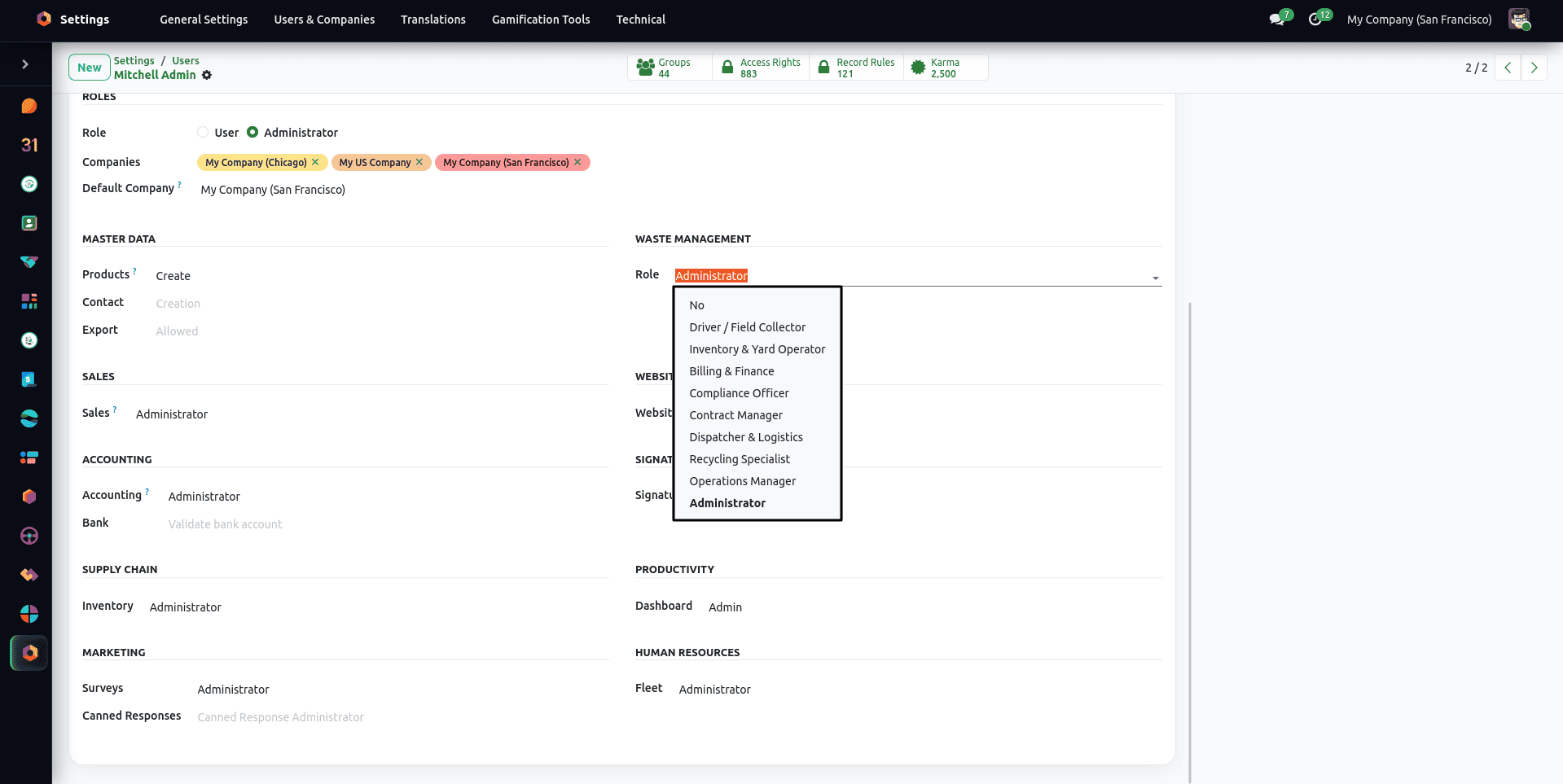
The module offers 8 distinct operational roles, plus specific permissions for digital signatures and contract management. The Driver / Field Collector can view their allocated daily routes and log collected weight using a mobile device but does not have permission to edit customer contracts. The Dispatcher & Logistics role creates and sends out collection orders, handles service zones, and route optimization. The Inventory & Yard Operator is responsible for weighing trucks at the yard, recording batches of incoming waste, executing sorting of materials, and printing barcodes as required. The Recycling Specialist creates and manages material recovery orders, records the amount of recovered material, and records the yield recovery rate.
The Billing & Finance role deals with setting dynamic pricing, performing monthly invoicing, and verifying draft customer invoices. The Operations Manager manages the overall operations, including dispatching, inventory of the yard, recycling, and fleet preparation. The Administrator role grants access to global configuration, user security assignments, and immutable audit logs. In addition, there are Signature User and Signature Manager roles managing multi-role signing processes and digital signature templates, as well as Contract Manager.
Configuring Global Settings and Storage Locations
If you want to create your first collection order, you need to configure the module in Waste Management > Configuration > Settings. This is where you turn on the immutable audit trail, auto-dispatching of routes ready for delivery, tracking of missed collections, geographic service areas, batch inspection, and barcode label creation.
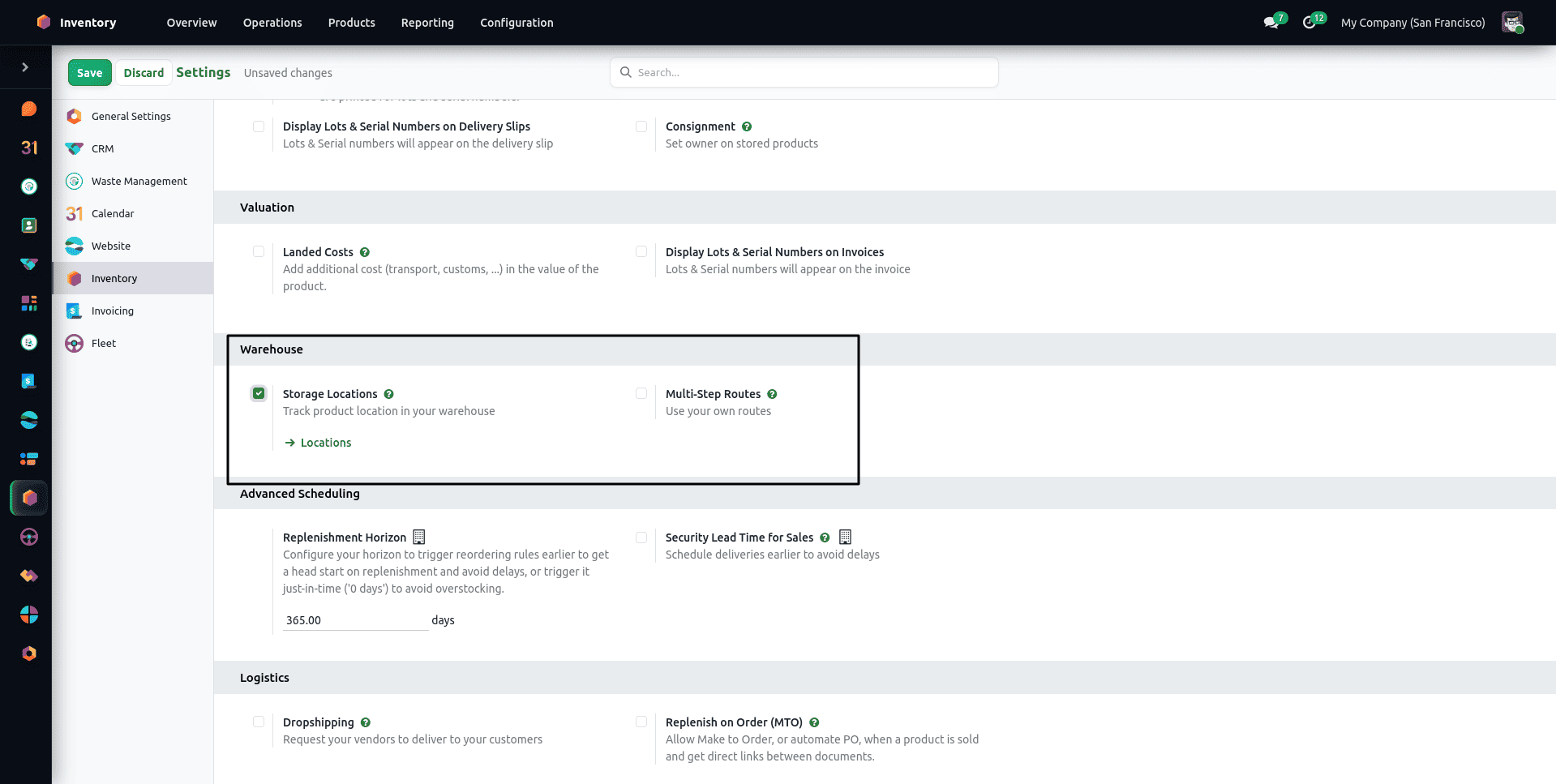
The module also enables Odoo's internal storage locations so that every waste batch can be traced all the way from the collection point to the disposal or recycling facility. Route and collection point map displays are powered by an integrated Leaflet and OpenStreetMap engine, providing interactive GIS mapping without requiring external third-party API keys.
Setting Up Waste Categories and Materials
The first thing to set up is the hierarchy of waste types the company handles. This is done from Waste Management > Configuration > Master Data > Waste Categories.
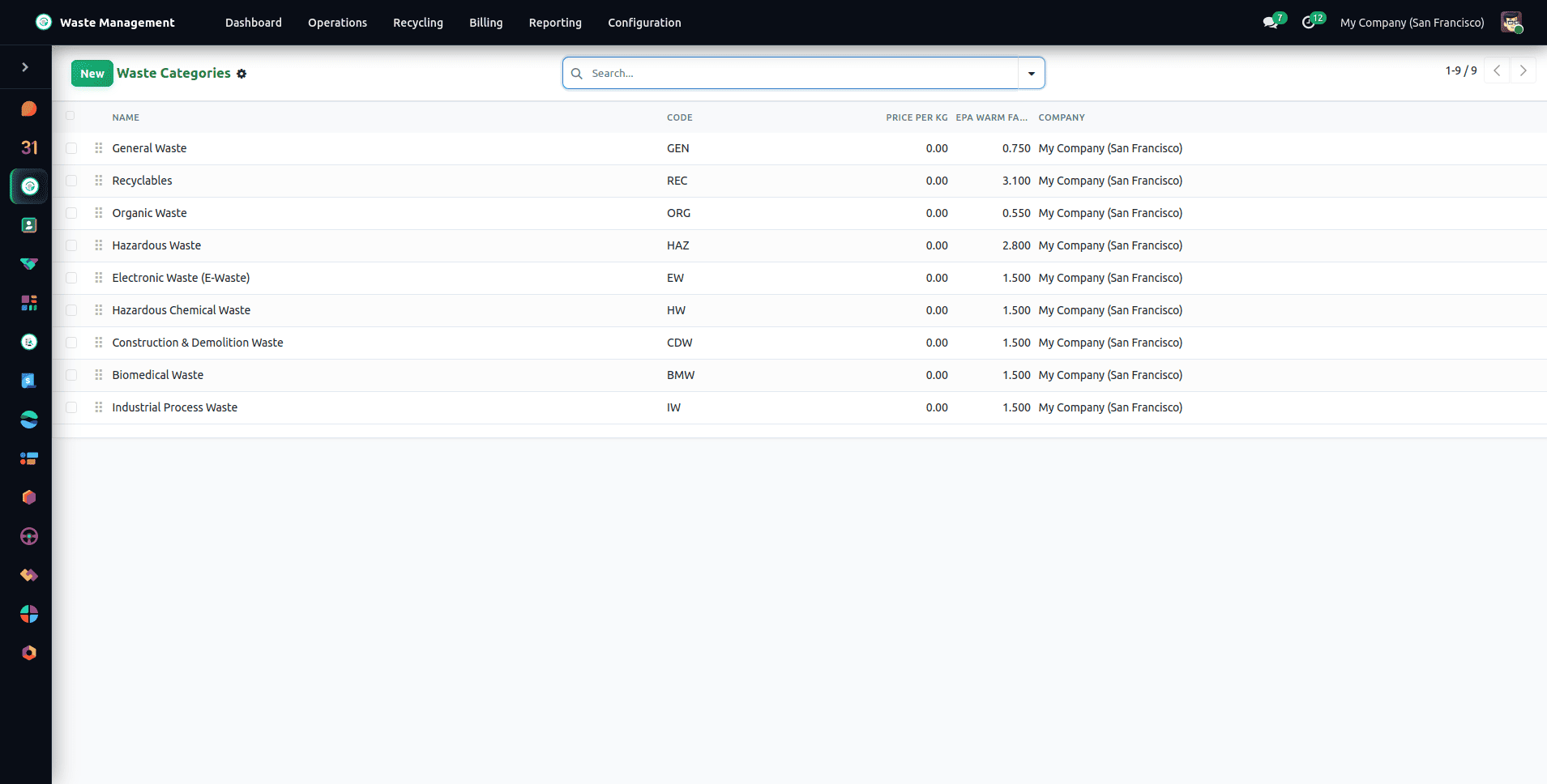
Each category carries a name, a unique code used across reports, manifests, and billing rules; a hazardous flag that enforces mandatory compliance documentation and licensed transport; a default container type that pre-fills collection orders; and a custom color code used on the interactive map view and dashboard charts.
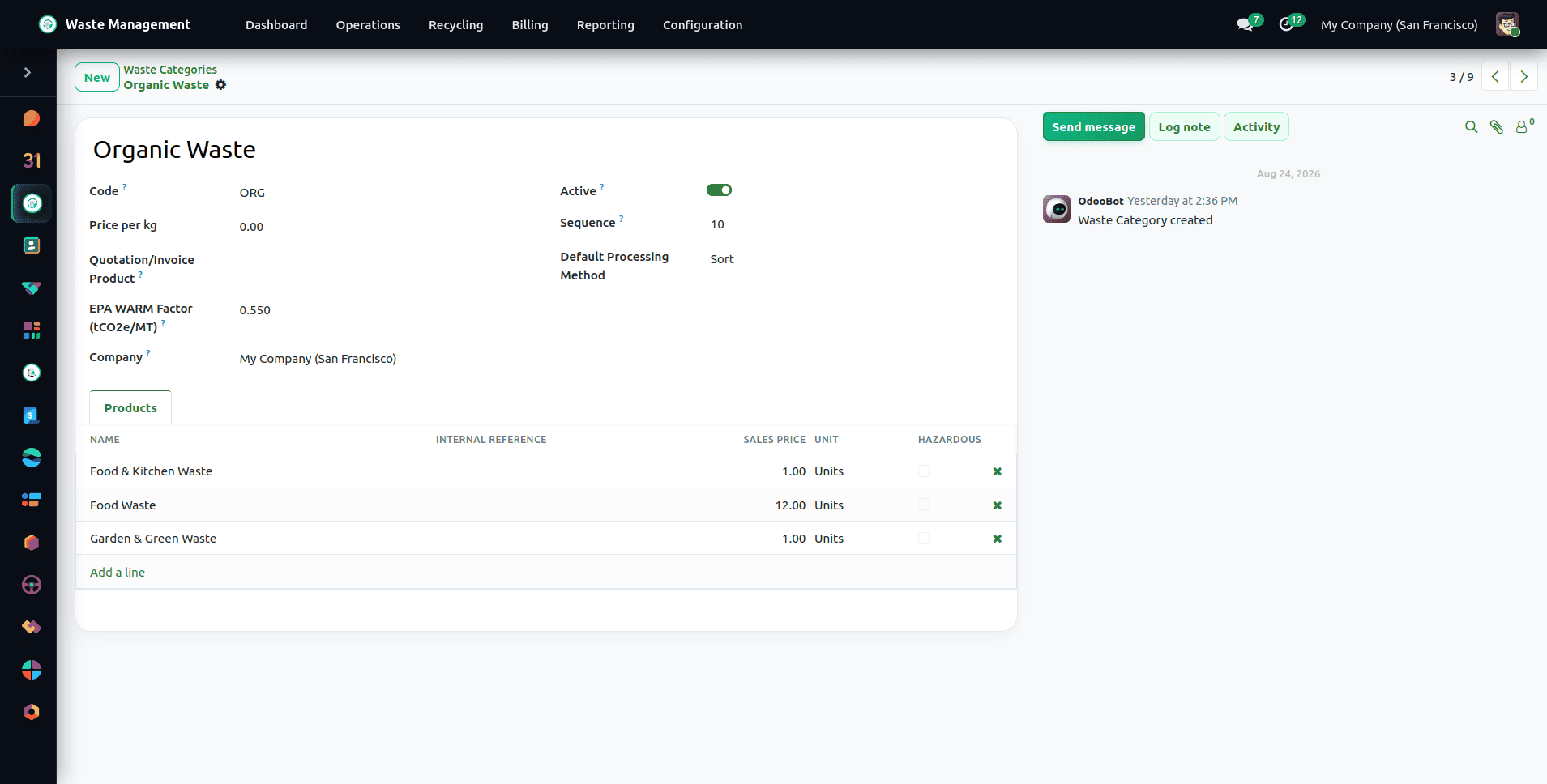
Under Waste Management > Configuration > Master Data > Waste Materials, you then define the specific materials belonging to each category – for instance, the Plastic category might hold PET Clear Bottles, HDPE Drums, and Polystyrene Foam.
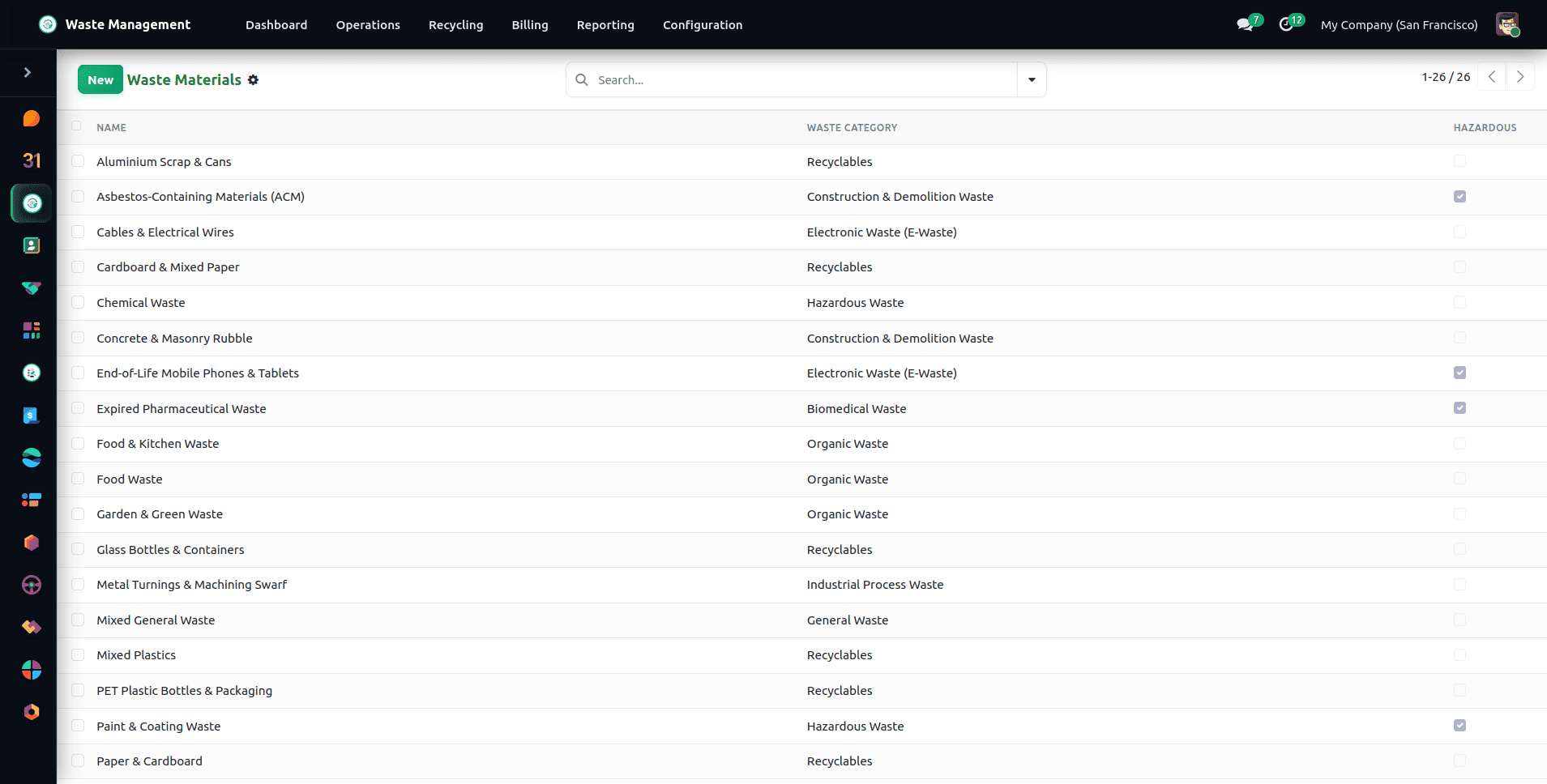
Each waste material is linked to an Odoo product template. Enabling the Is Waste Material flag on a product makes it selectable in collection orders, waste batches, and recycling orders.
Managing Partner Contracts and Commercial Terms
On the commercial side, customer agreements are governed by Partner Contracts from Waste Management > Configuration > Customer > Contracts. A Partner Contract sets the commercial terms for a customer's waste collection and billing.
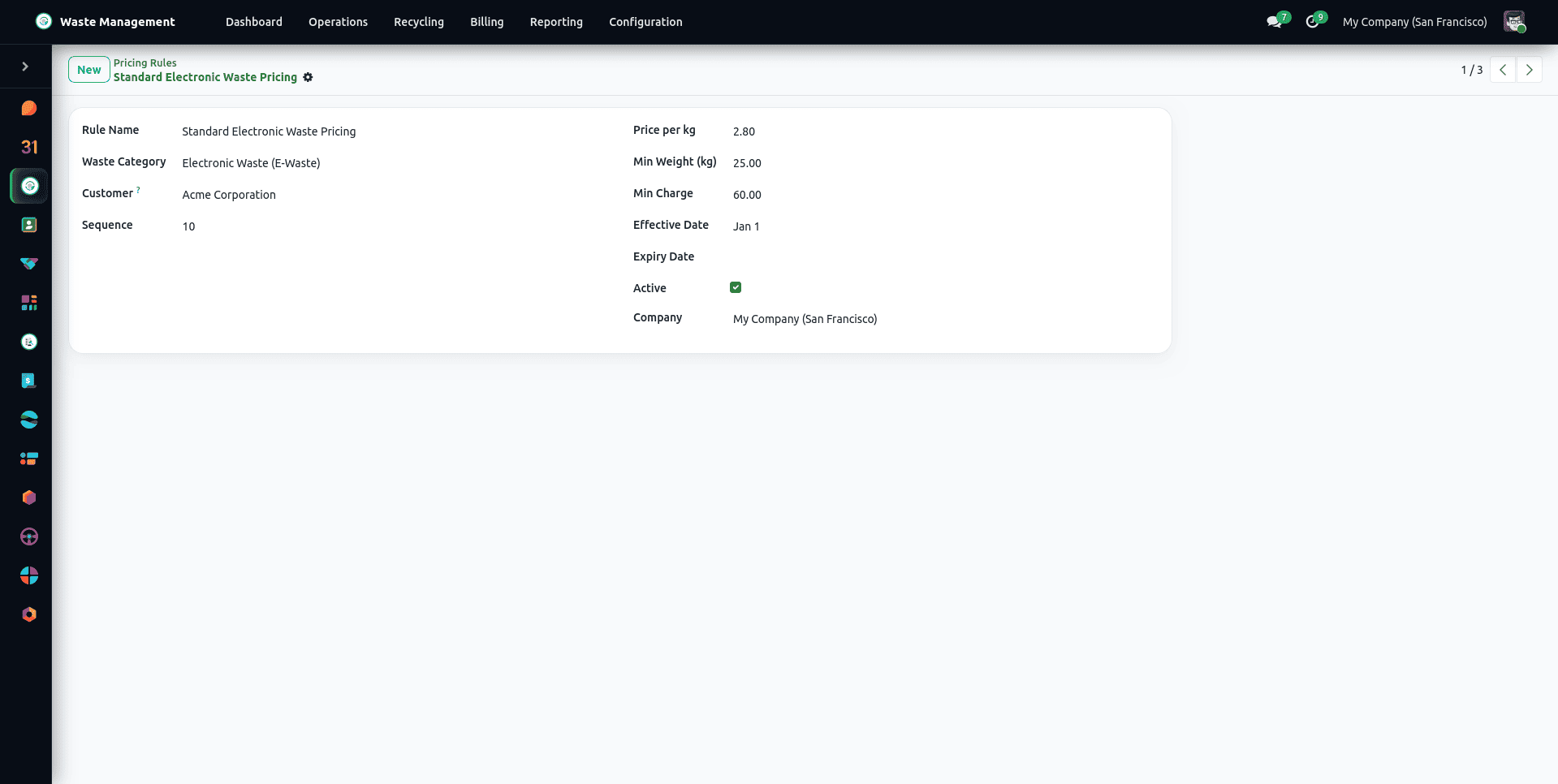
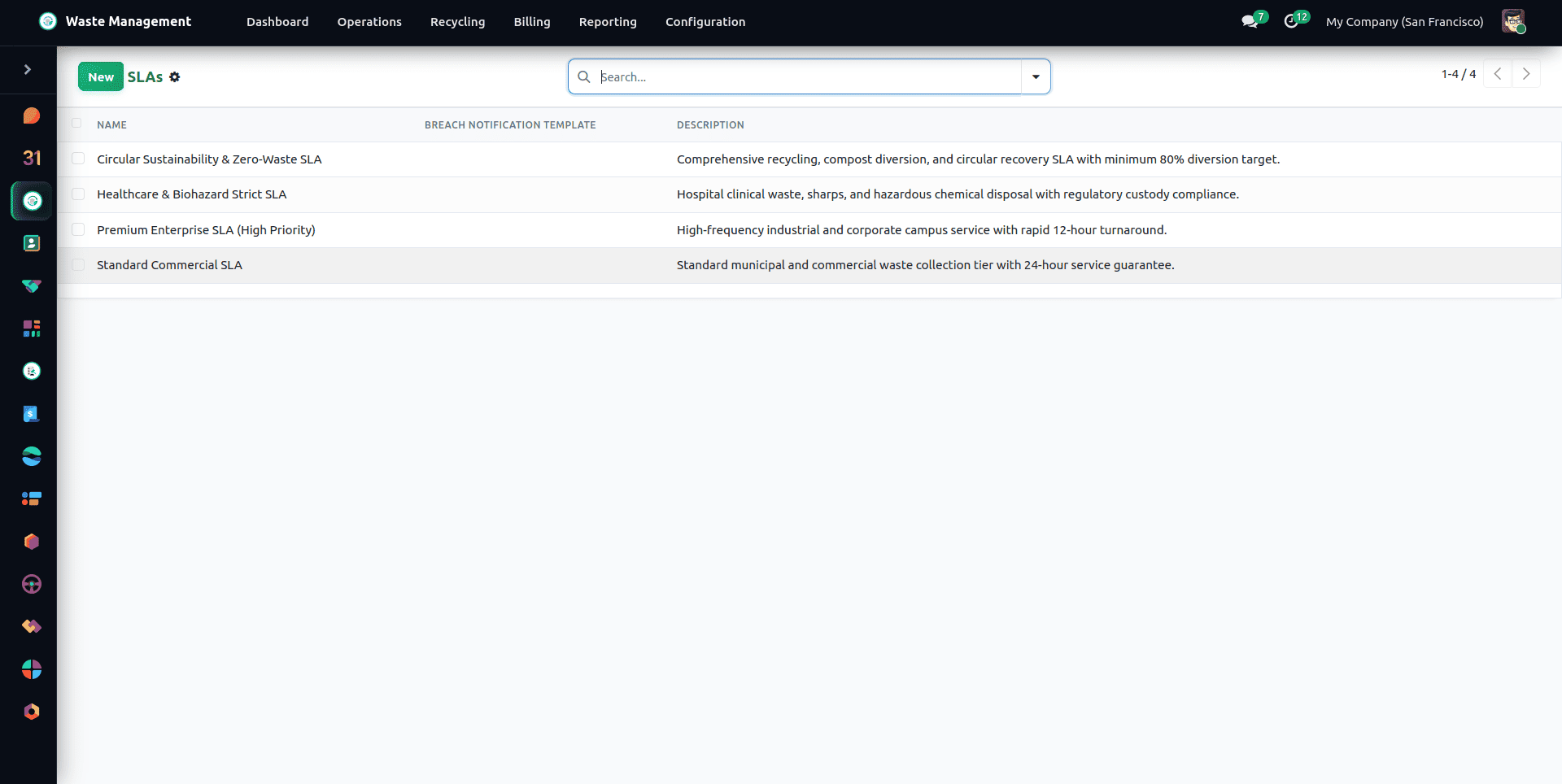
In the contract header, the billing scheme is specified: Per Collection (fixed stop fee), Per Material, Base Fee + Material Overage (the base fee will cover the threshold tonnage, and extra tonnage will be charged at an overweight cost per 10 kg), and Per Category Rate (rates are set in kilograms on the contract lines). The entire contract will define the billing period, collection locations, and SLA targets for collection compliance, missed collections, and complaint response time.
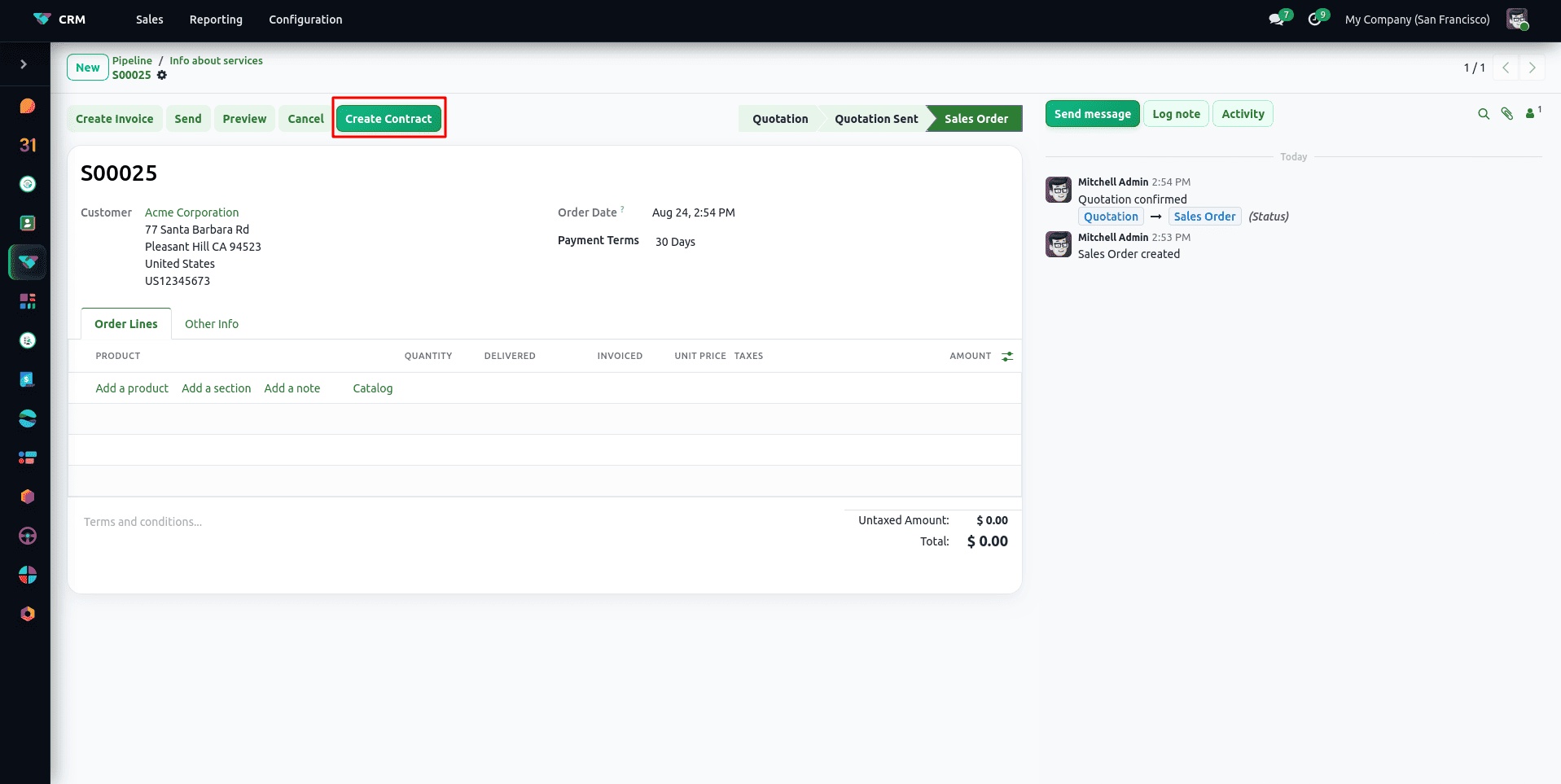
CRM leads and quotations in Odoo are extended with a Waste Management tab, allowing sales teams to convert won opportunities directly into active partner contracts using the Convert to Contract wizard.
Registering Geolocated Collection Points
With categories and contracts in place, the next step is to register where waste is physically collected. A Collection Point is a customer site, commercial facility, or industrial skip that you create from Waste Management > Operations > Collection Points.
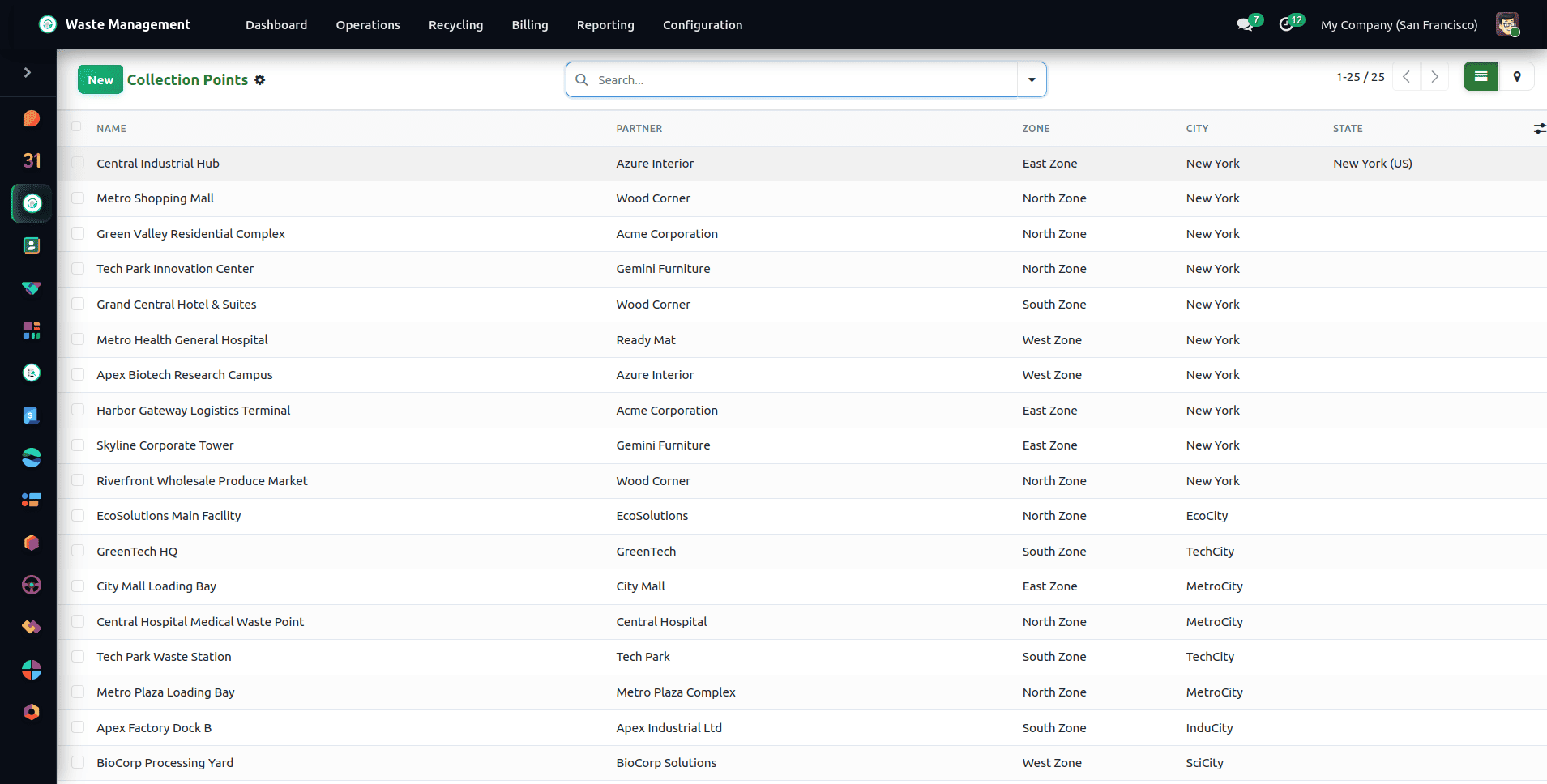
The information held at each collection point includes the responsible partner, the service area assigned to that partner, the GPS latitude and longitude, the types of waste that are allowed, the type of container and the number of containers placed at the site, as well as the collection frequency. When the GPS coordinates have been entered, the pin will appear on the interactive Leaflet map, allowing dispatchers to check the position before assigning the point to a route.
Executing Collection Orders and Mobile Weight Logging
With master data in place, the day-to-day operations start with the Collection Order. The Collection Order is the operational transaction that captures the collection of a single pickup at a collection point and is managed from Waste Management > Operations > Collection Orders.
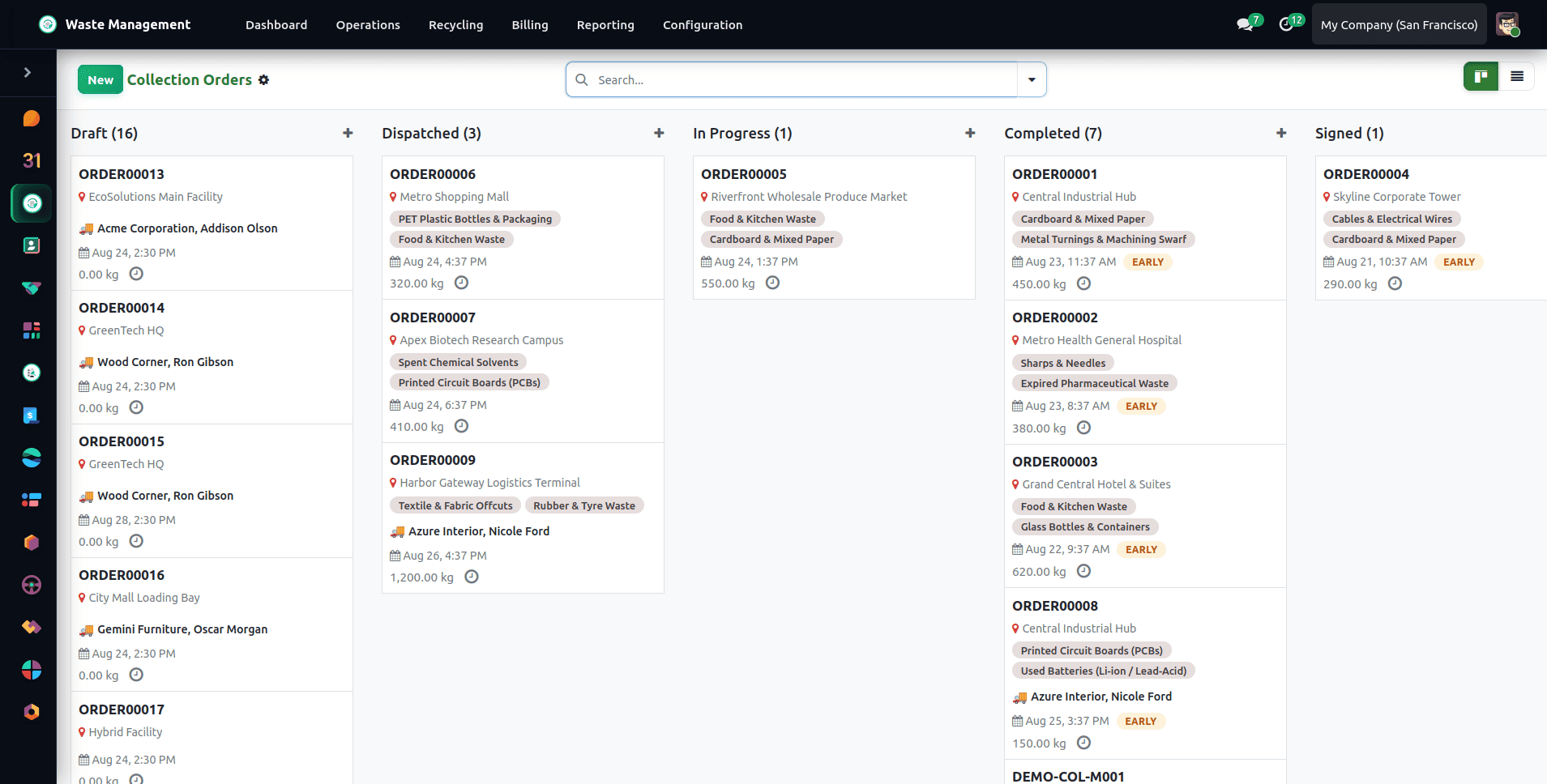
The life cycle of a collection order is definite and consists of the stages Draft, Dispatched, In Progress, Completed, and Signed (Missed and Cancelled being exceptions). The collection order may be automatically generated according to the contract's recurrence schedule, by adding stops to the route map, or even by manual input from dispatchers. When you click on Dispatch the driver, the vehicle and the date are assigned, and the order is then entered on the driver's run sheet.
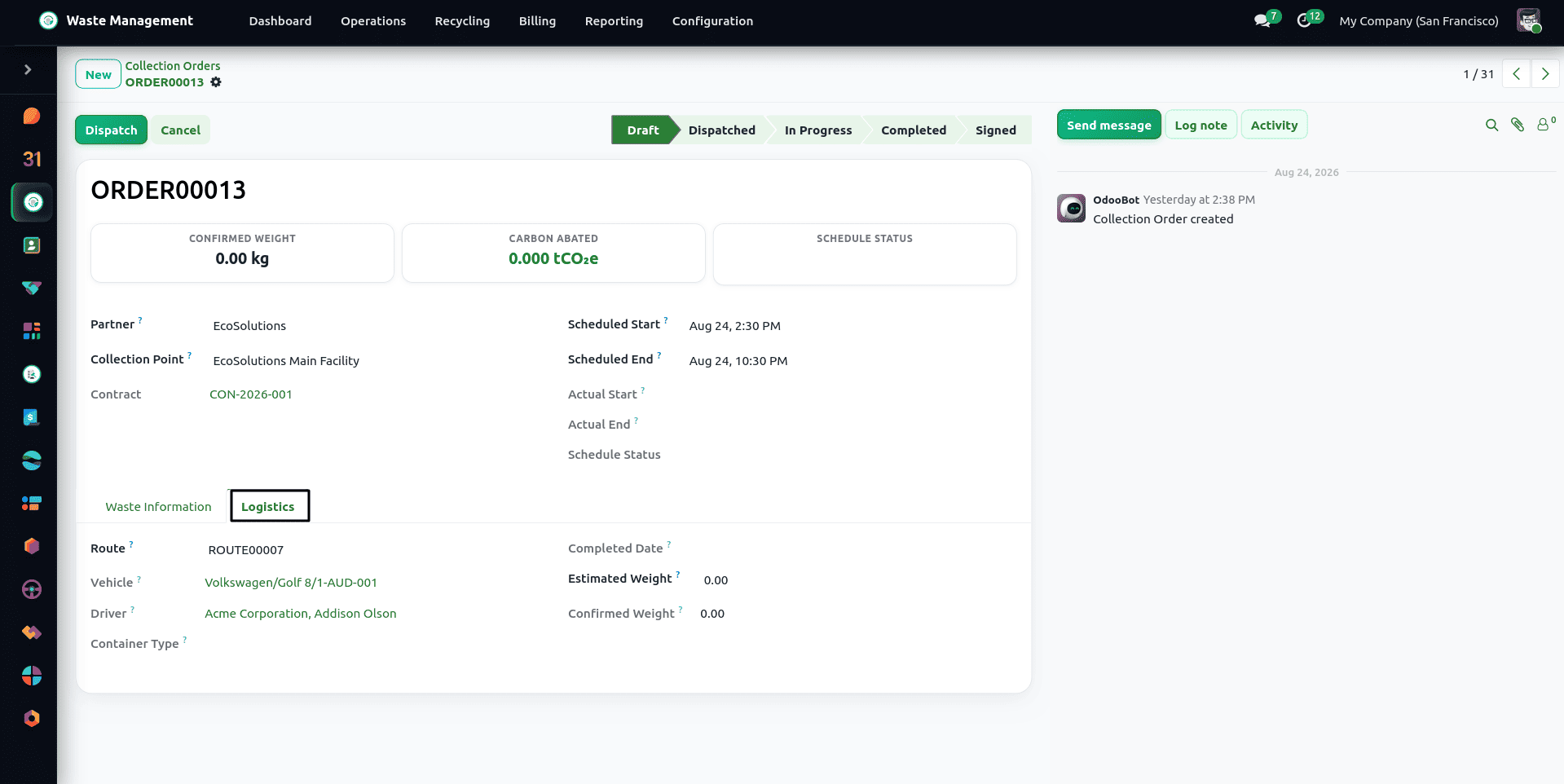
When the driver arrives on site and begins the pickup, the order moves to In Progress. The driver logs the actual net weight collected for each waste stream, may optionally take a photo, and mark the pickup as Completed. Once the customer signs on site, the digital touch signature moves the order to Signed:
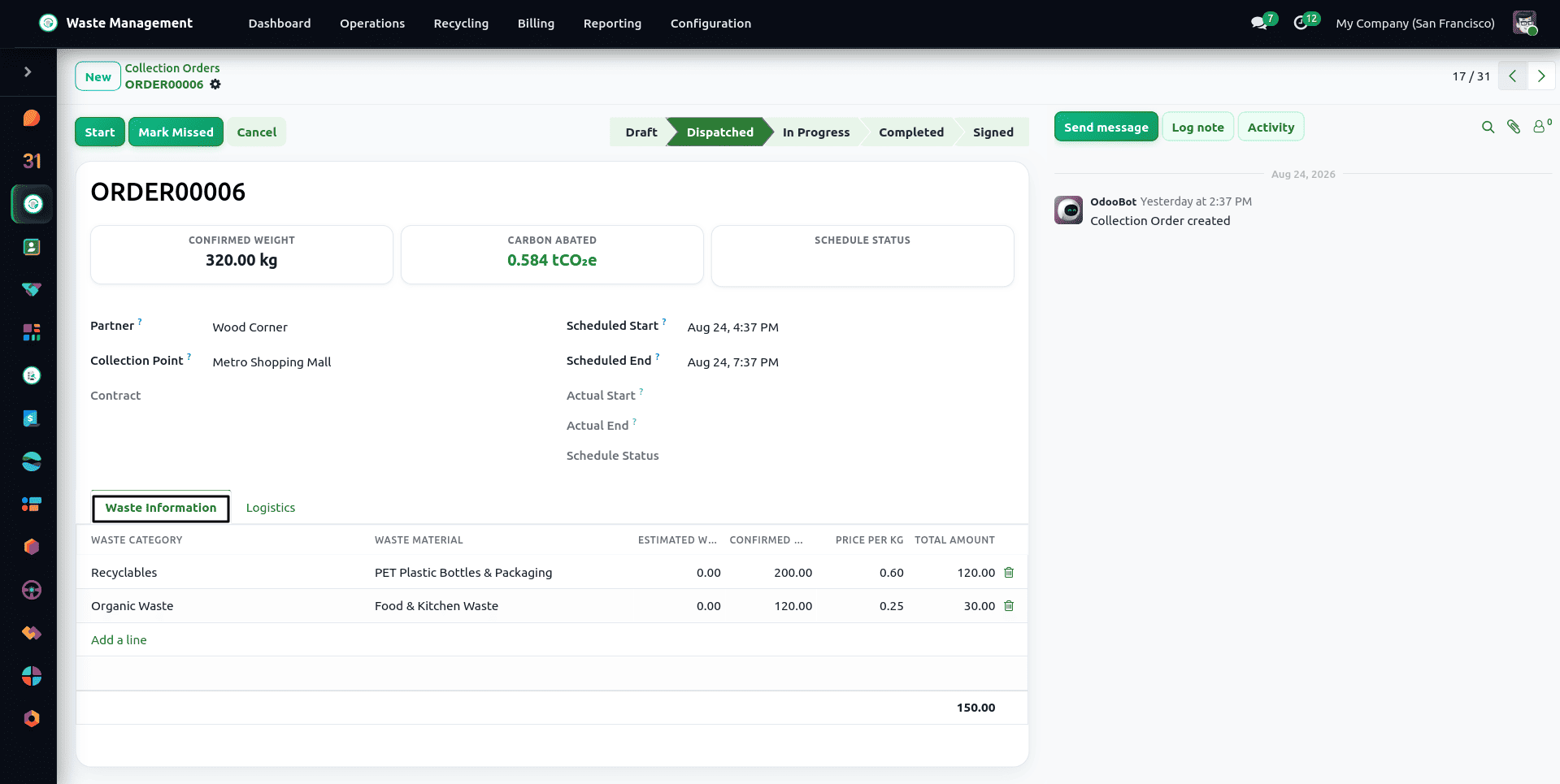
When actual weights are entered, the system will automatically calculate the bill amount based on that customer’s contract rate card for the waste category collected (defaults to the default rate for the category if no contract exists).
Route Planning, Leaflet Mapping & 1-Click Optimization
A Route is a collection of the collection points a vehicle visits in a single shift (To Start > Dispatched > Running > Completed). It is managed from Waste Management > Operations > Routes.
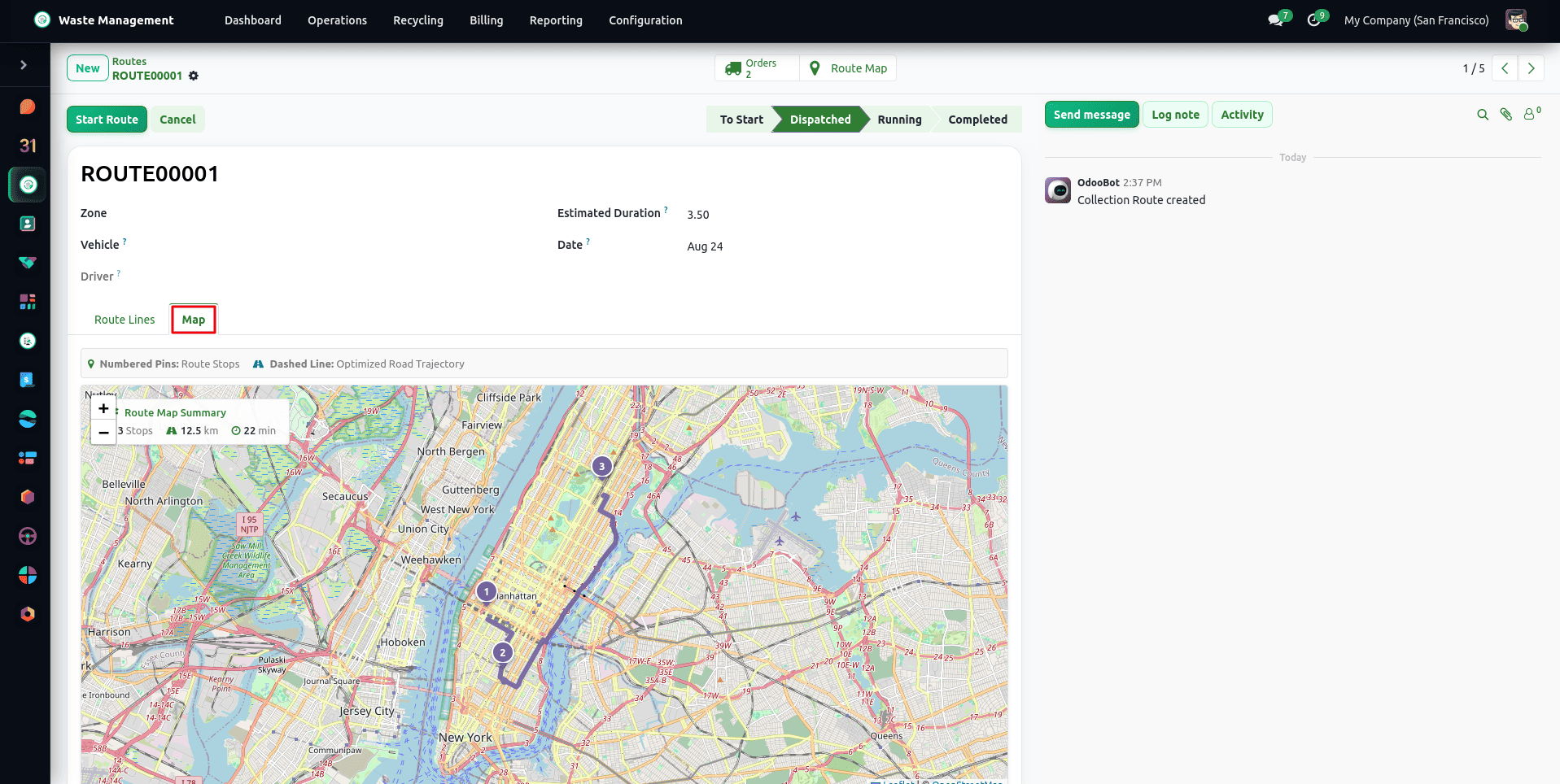
Routes can be either manually built or generated automatically by recurring schedules per area. Hit Optimise Route, and it’ll run a Travelling Salesman Problem algorithm across the GPS coordinates of every stop and reorder them to minimise the total travel distance and fuel consumption.
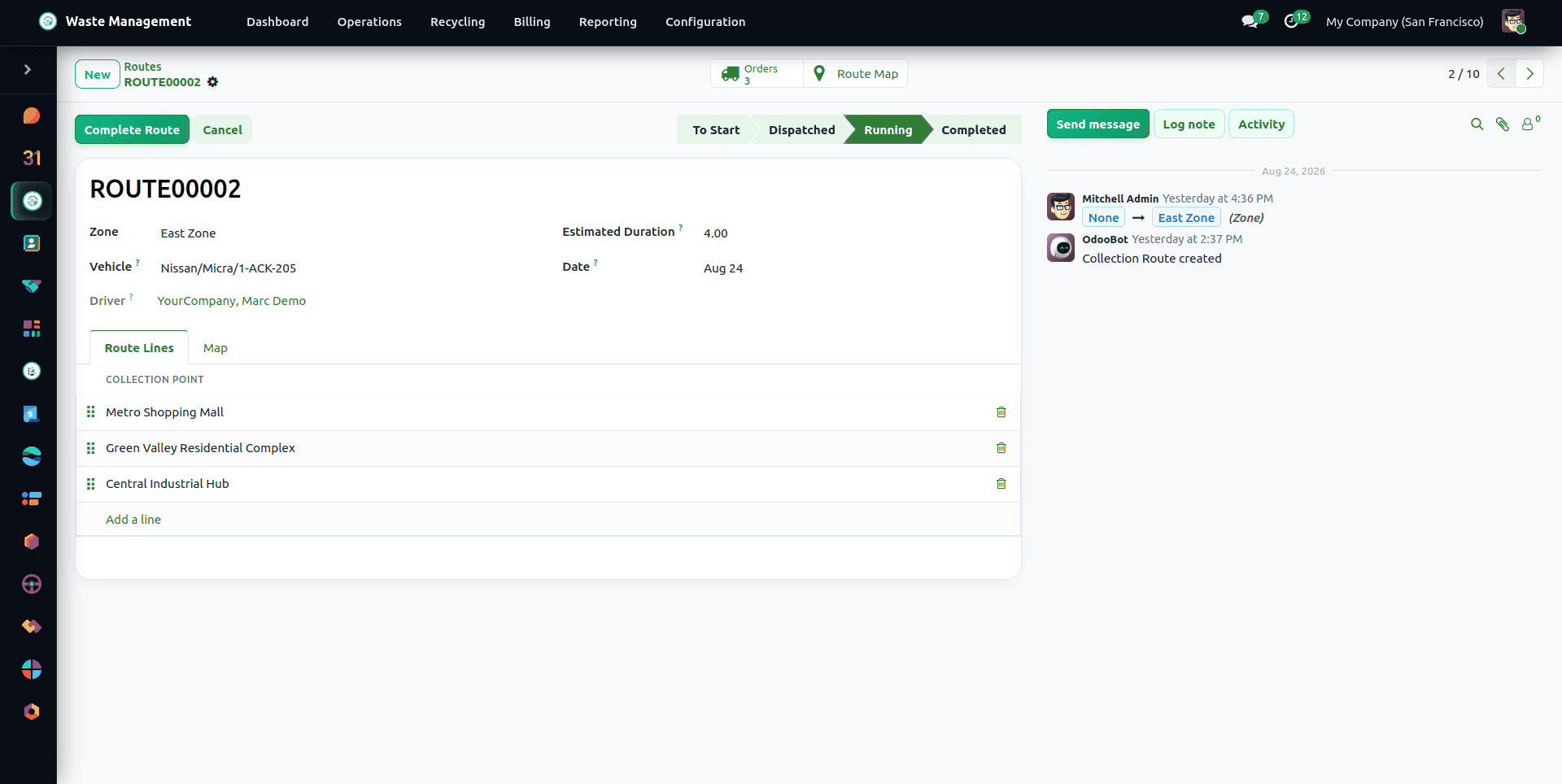
Dispatchers can manually drag stops on the route table, print a formatted Route Sheet PDF for the driver, and track live stop completion progress as the driver executes the run.
Managing Missed Collections and SLA Tracking
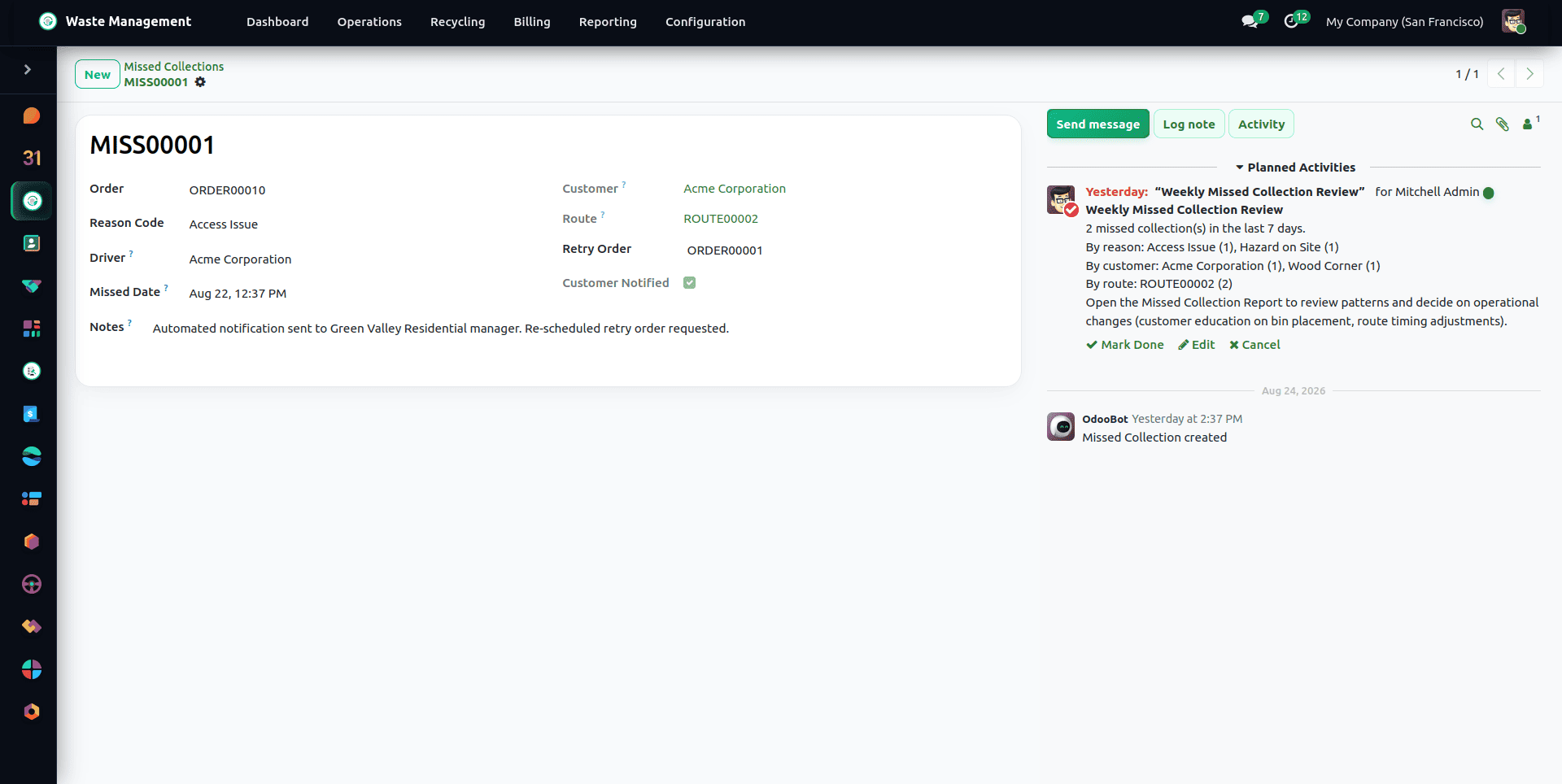
If a collection point is missed outside of the missed-collection threshold, the system automatically creates a Missed Collection record under Waste Management > Operations > Missed Collections and alerts the dispatcher and customer contact.
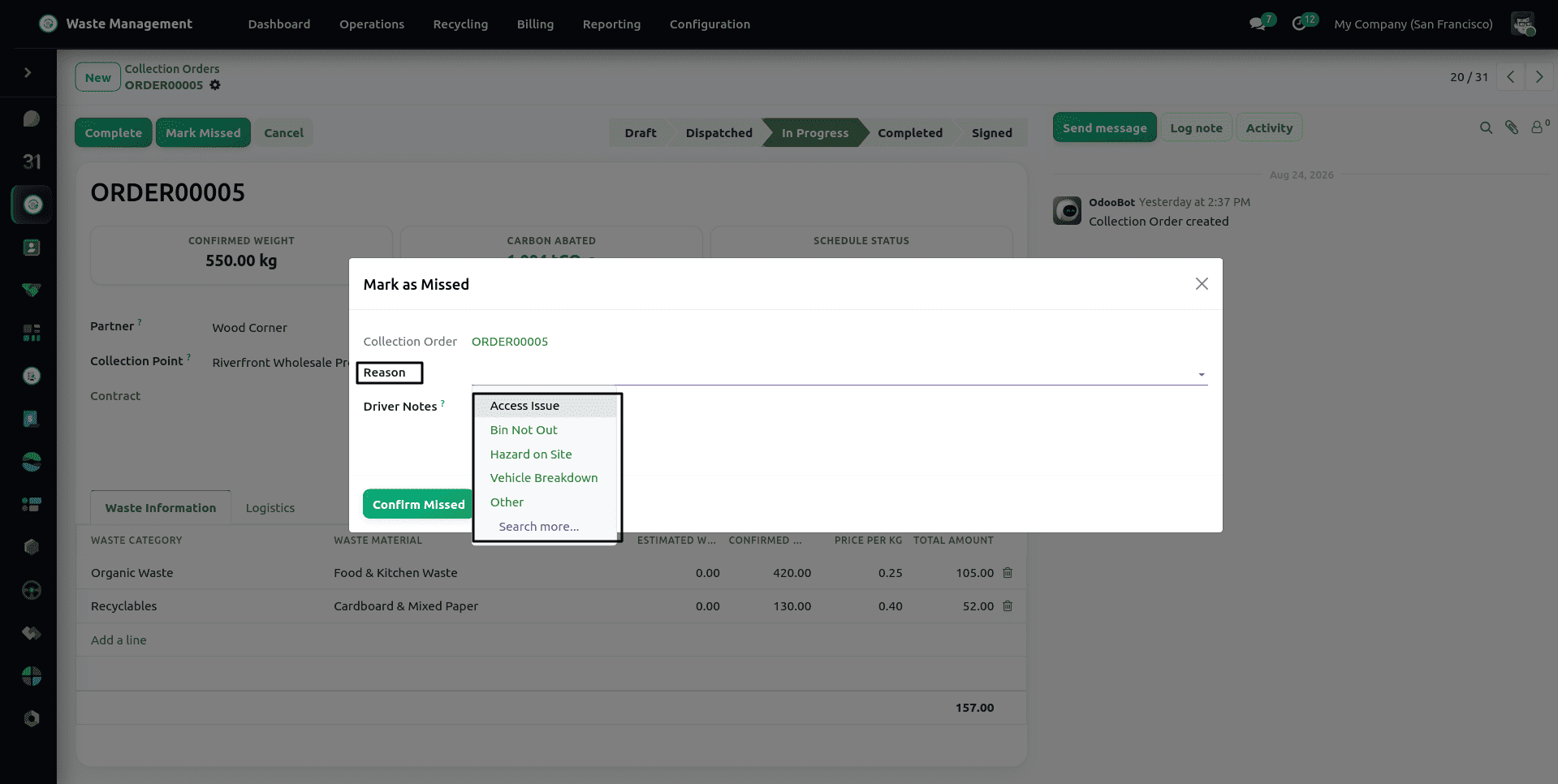
A driver or dispatcher can also flag a collection as missed manually using the Mark as Missed wizard, selecting a root cause reason (Access Denied, Vehicle Breakdown, Customer Not Available, Weather, or Other) and entering a note.
When a collection is missed, the missed count for that collection item is increased, an automated follow-up action is set up for rescheduling, and the SLA compliance score of the customer contract is updated.
Fleet Roadworthiness and Vehicle Safety Checklists
The vehicles that run these routes are managed from Fleet > Vehicles, extending Odoo's native Fleet module with a dedicated Waste Management tab.
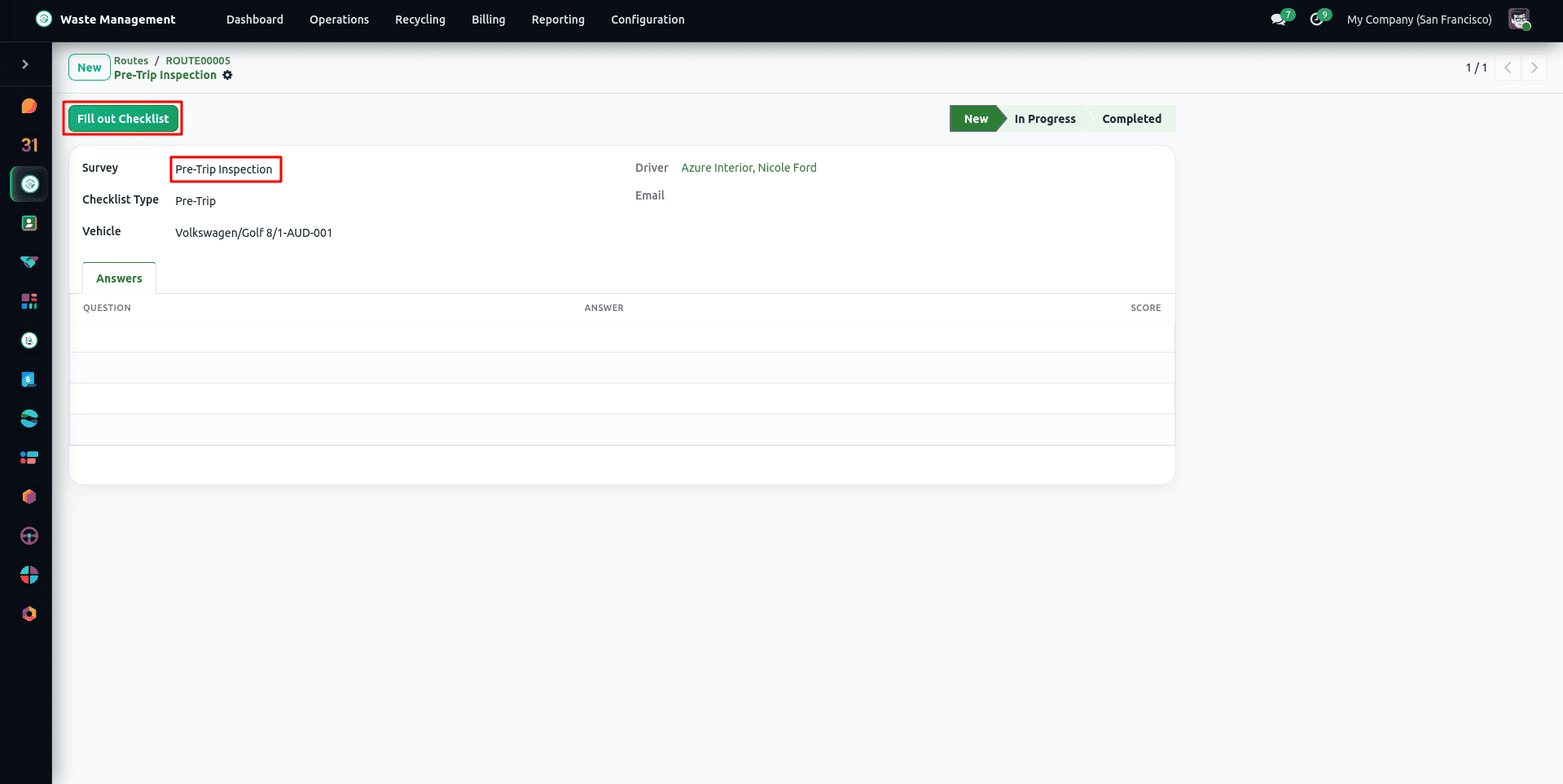
Each vehicle has a maximum load capacity (kg), with an overload alert if the planned weight of a route exceeds the limit, a list of accepted waste streams (hazardous waste needs an ADR-accredited vehicle), and relevant compliance certificates. All drivers are required to complete the mandatory Pre-Trip and Post-Trip Safety Checklist procedures, and any defects found must be reported immediately to the fleet manager. The Certificate & Licence Expiry Report automatically tracks renewal periods for all permits, certificates of insurance, and roadworthiness certificates.
Automated Waste Batch Generation and Weighbridge Intake
At the end of collection routes or standalone collection orders, Waste Management ERP automatically synthesises or aggregates inbound Waste Batches categorised by waste stream category under Waste Management > Operations > Waste Batches. Confirmed net weights, product lines and warehouse storage locations are instantly updated without manual re-entry of data. Batches can also be registered manually for direct customer drop-offs:
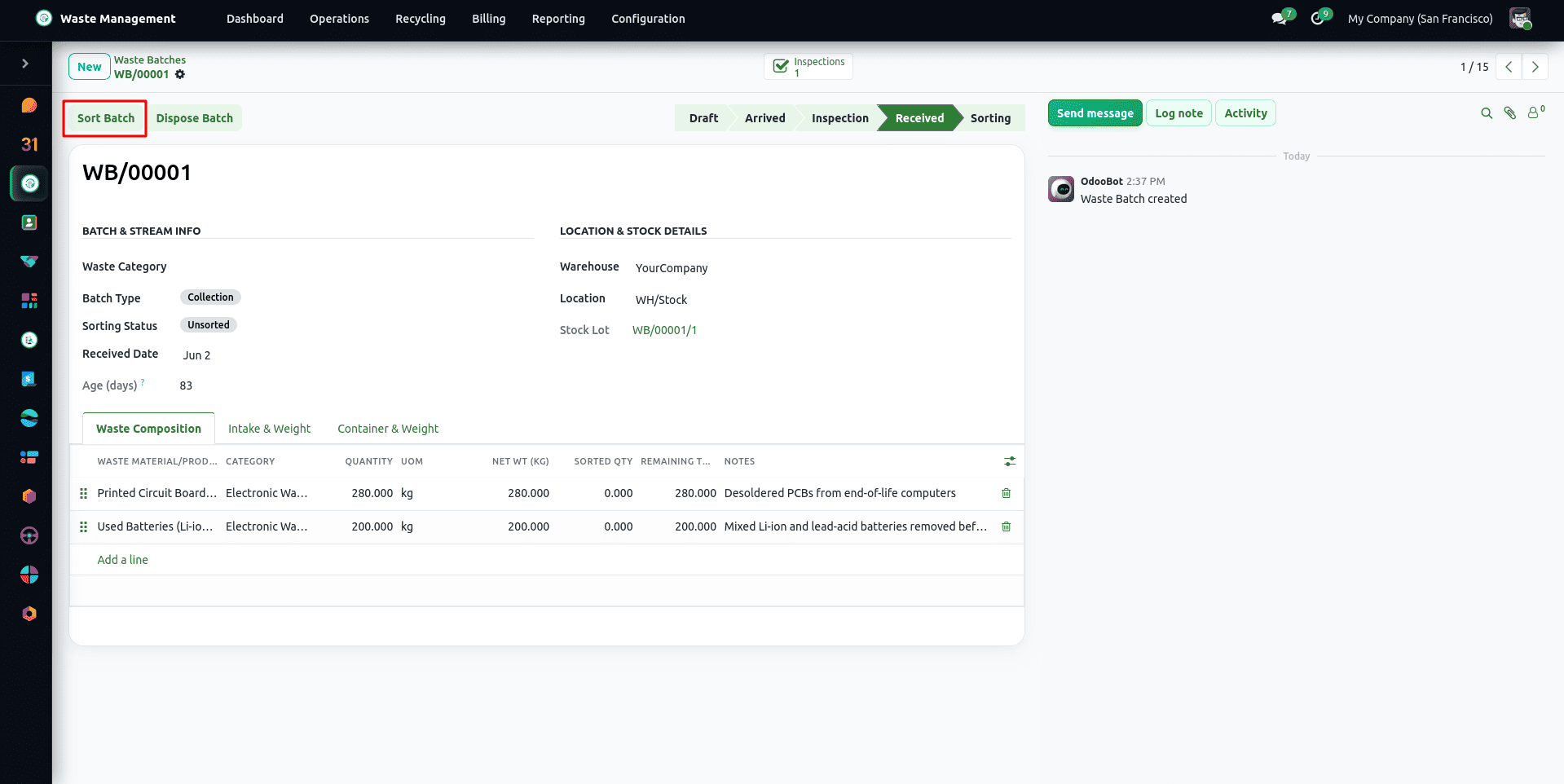
To obtain the exact net weight, the weighbridge operator records both the gross and tare weights. When the operator clicks Receive Batch, the intake is confirmed, and incoming stock moves are created and assigned to the facility's storage location. A barcode Waste Batch Label, including the hazard warning diamonds, can be printed directly from the form.
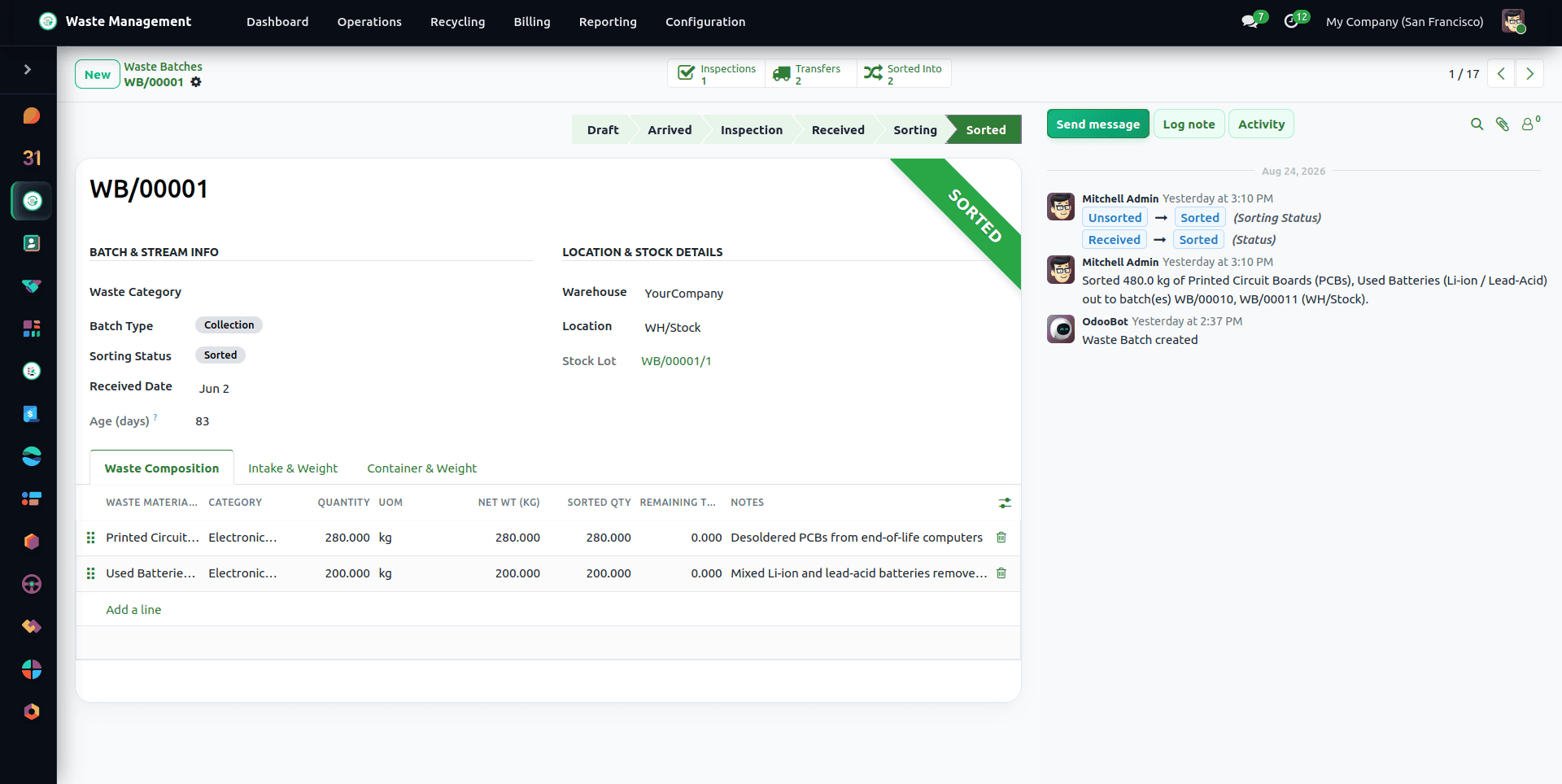
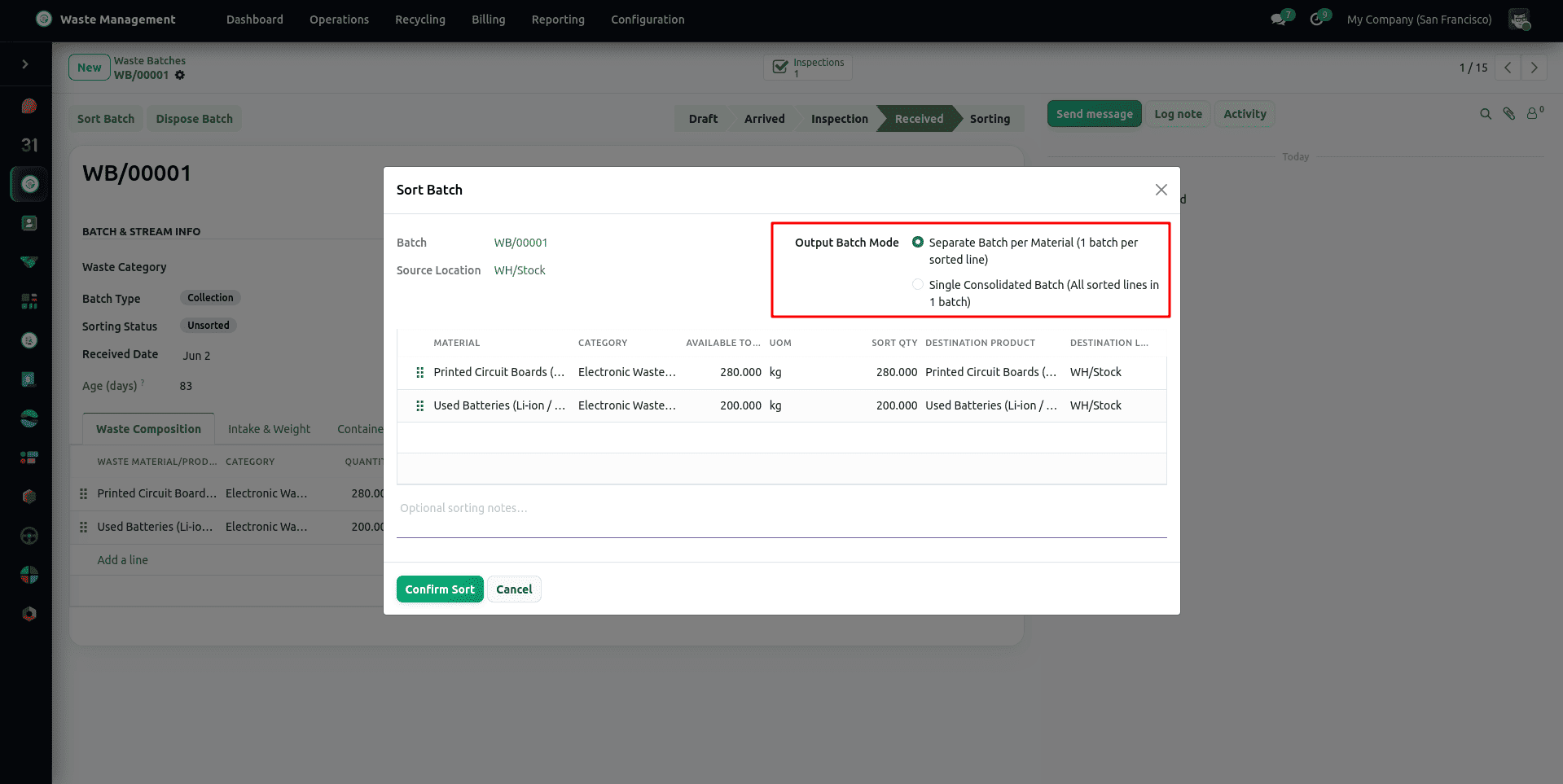
For mixed or co-mingled loads, operators use the Waste Batch Sorting Wizard to separate bulk waste into dedicated material sub-batches before recycling or disposal routing.
Batch Quality Inspections and Quality Approval Gates
When batch approval settings are enabled, incoming batches must pass a formal Batch Inspection from Waste Management > Operations > Batch Inspections before they can be received into warehouse stock or released for downstream recycling or disposal:
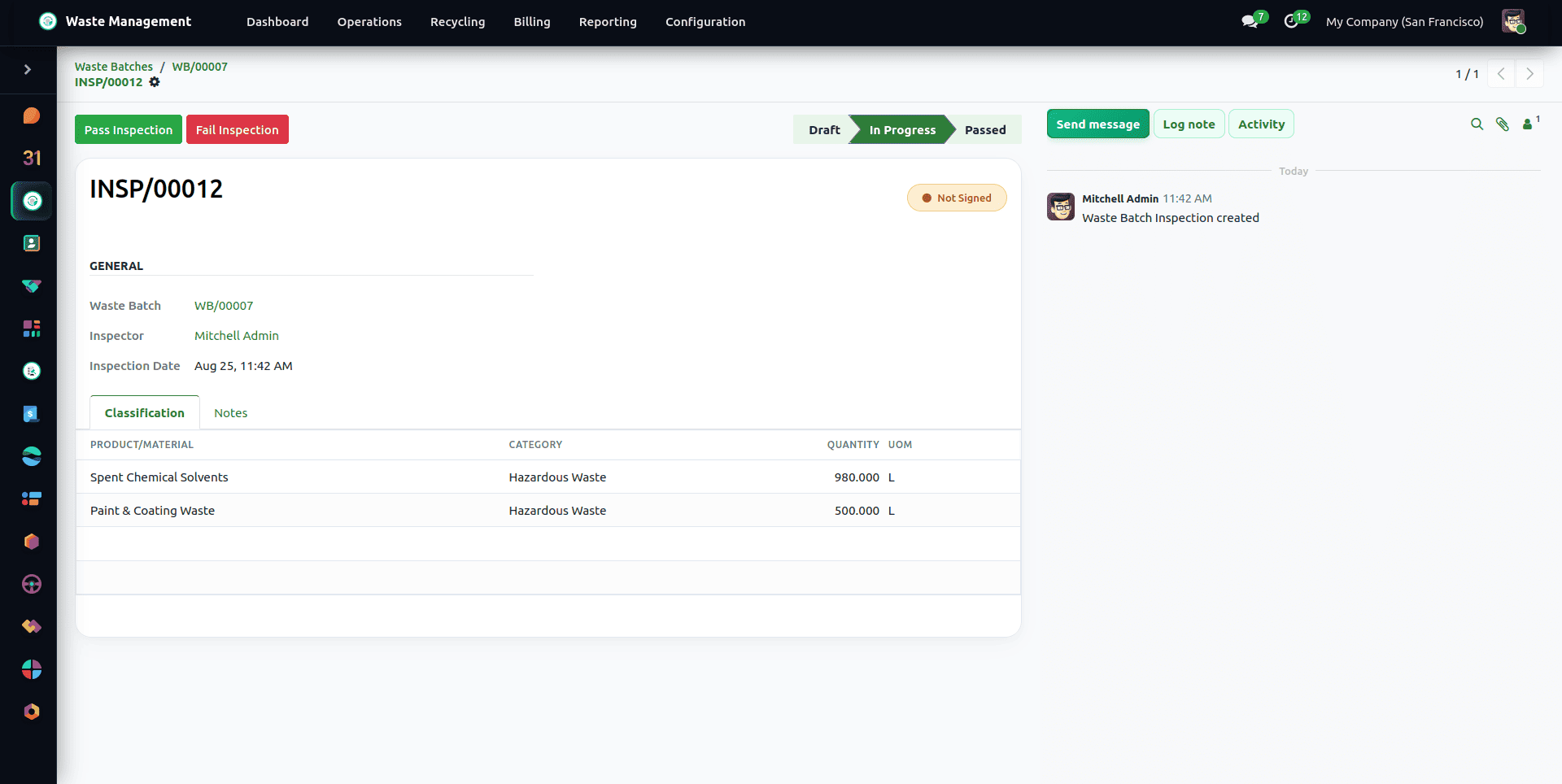
The inspection examines the batch for contamination caused by foreign streams, confirms its hazardous classifications and compares the weight recorded by the driver with the weight obtained from the weighbridge, taking into account a variance tolerance that can be configured. Batches that pass are approved for release, whilst those that fail are locked and sent for re-sorting. You can create an official Waste Inspection Report PDF within minutes directly from the form.
Recycling Operations, Yield Tracking & Scope 3 Carbon Accounting
Once a batch is received and inspected, recyclable streams move into a Recycling Order under Waste Management > Recycling > Recycling Orders (Draft > Confirmed > In Progress > Done).
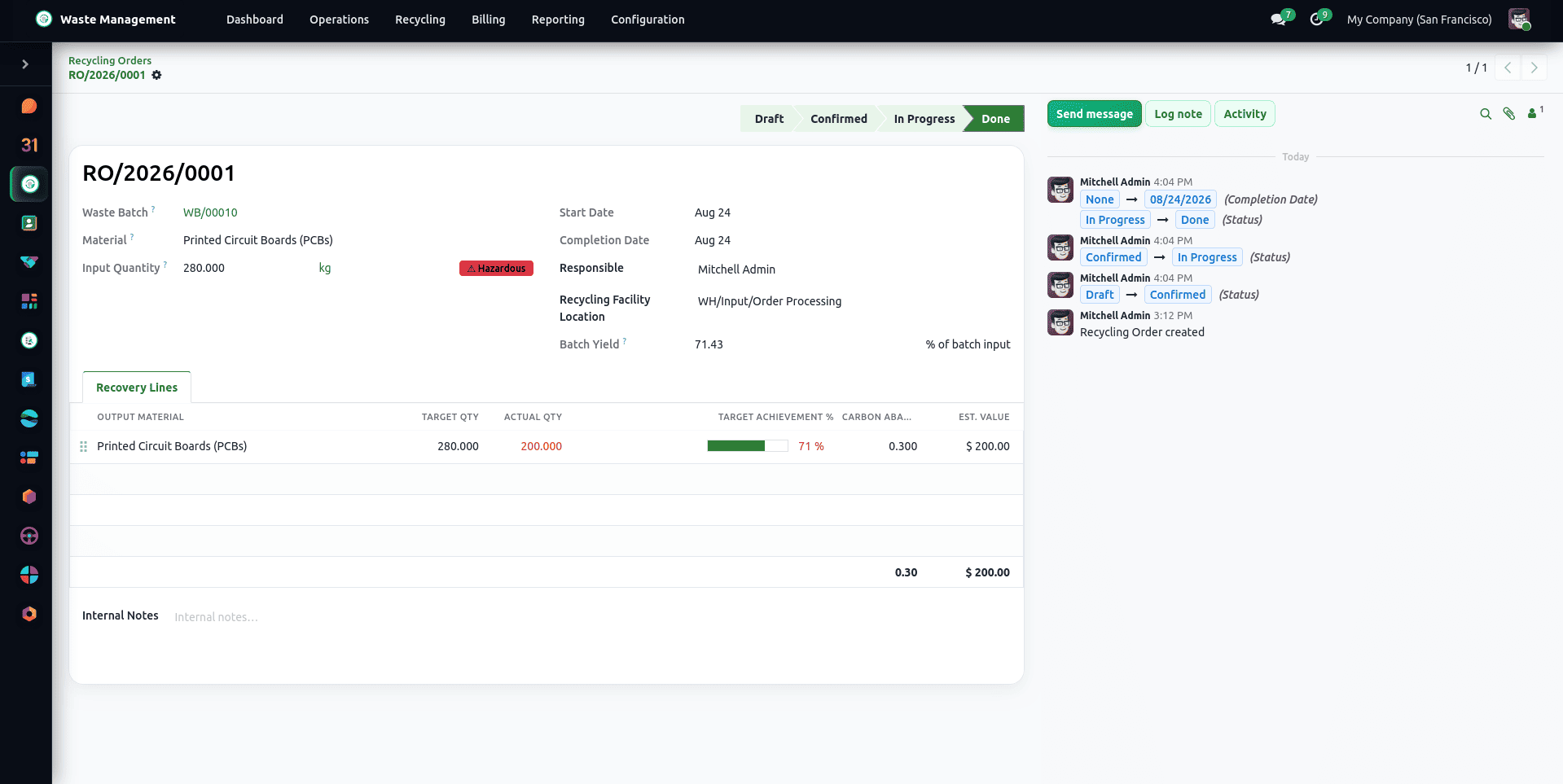
Every order can be traced to a specific source waste batch and includes recovery lines that show the input material, the recovered product, the target quantity, the actual recovered quantity, and the recovery yield per cent, the latter being automatically calculated. When an order is completed, the final recovery weights are locked in, and the inventory movements for the finished goods are recorded. Once the order is marked as completed, the operators can click on the 'Create Sale Order' button to automatically generate a draft Sale Order that is pre-filled so that the recovered commodities can be marketed:
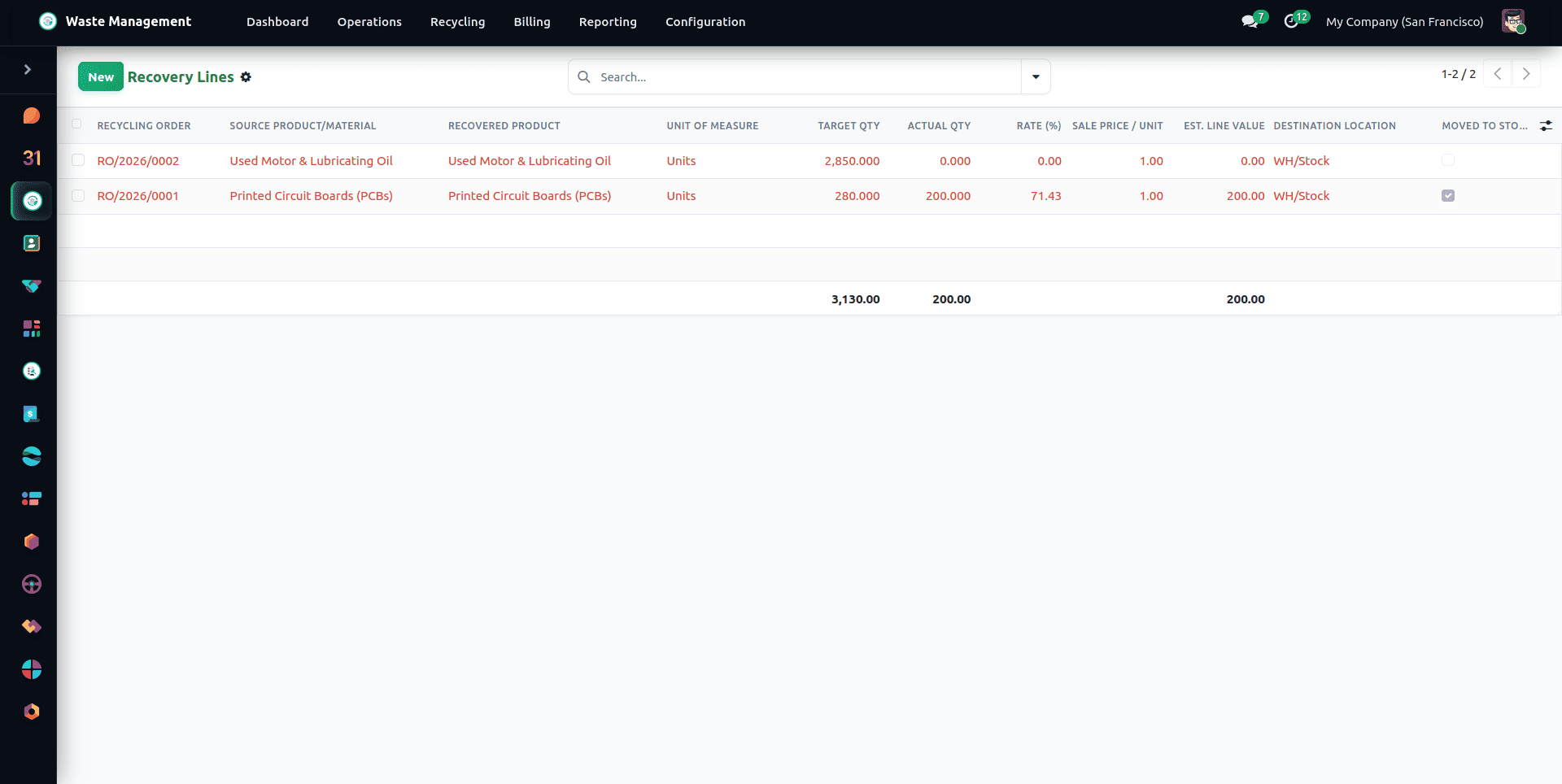
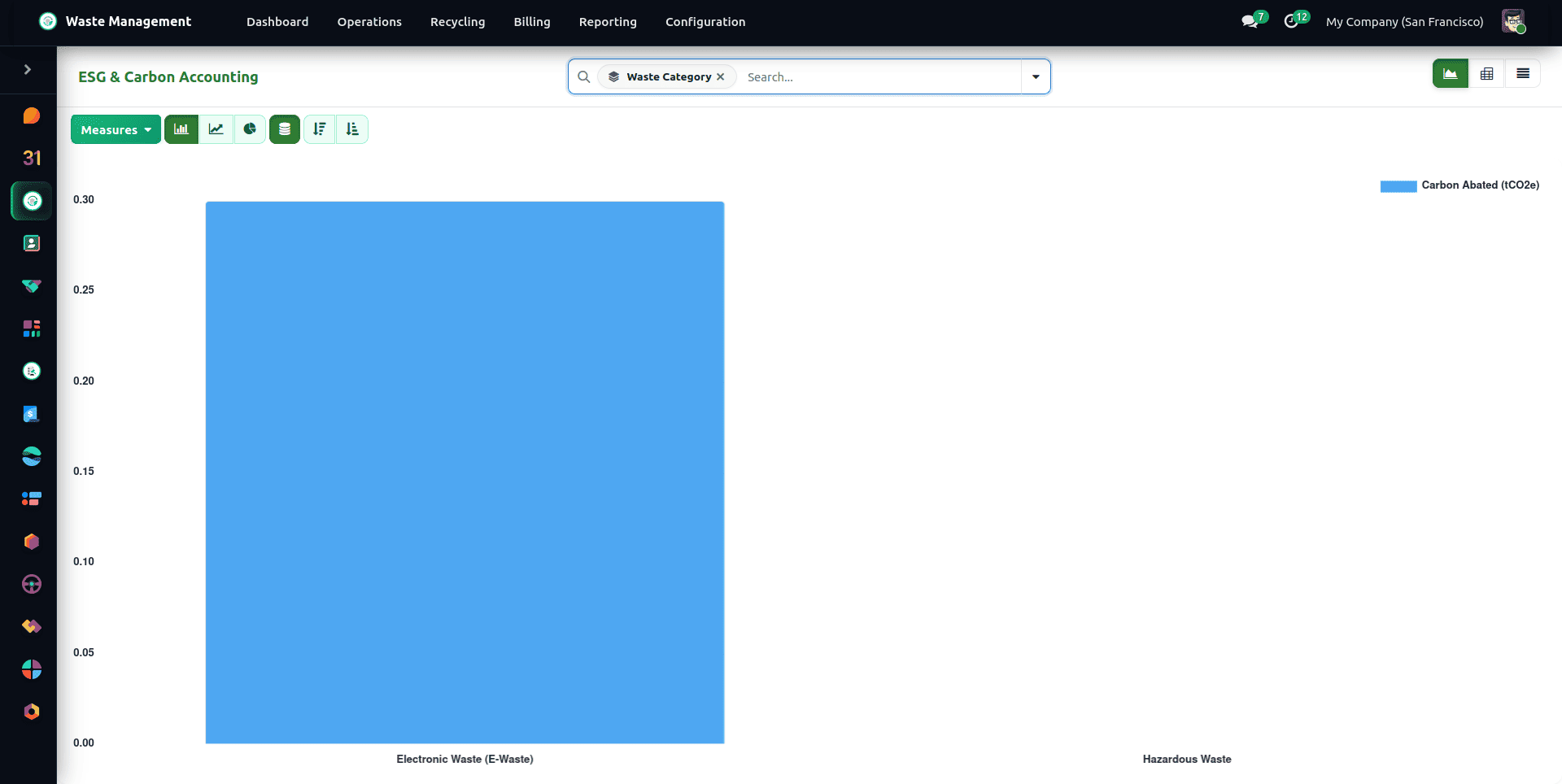
The Recycling Efficiency Report compares recovery rates across materials, while the ESG Scope 3 Carbon Accounting Report tracks net greenhouse gas (CO2 avoided) savings achieved by recycling versus landfill diversion based on EPA WARM standards:
Statutory Compliance Manifests and Chain of Custody
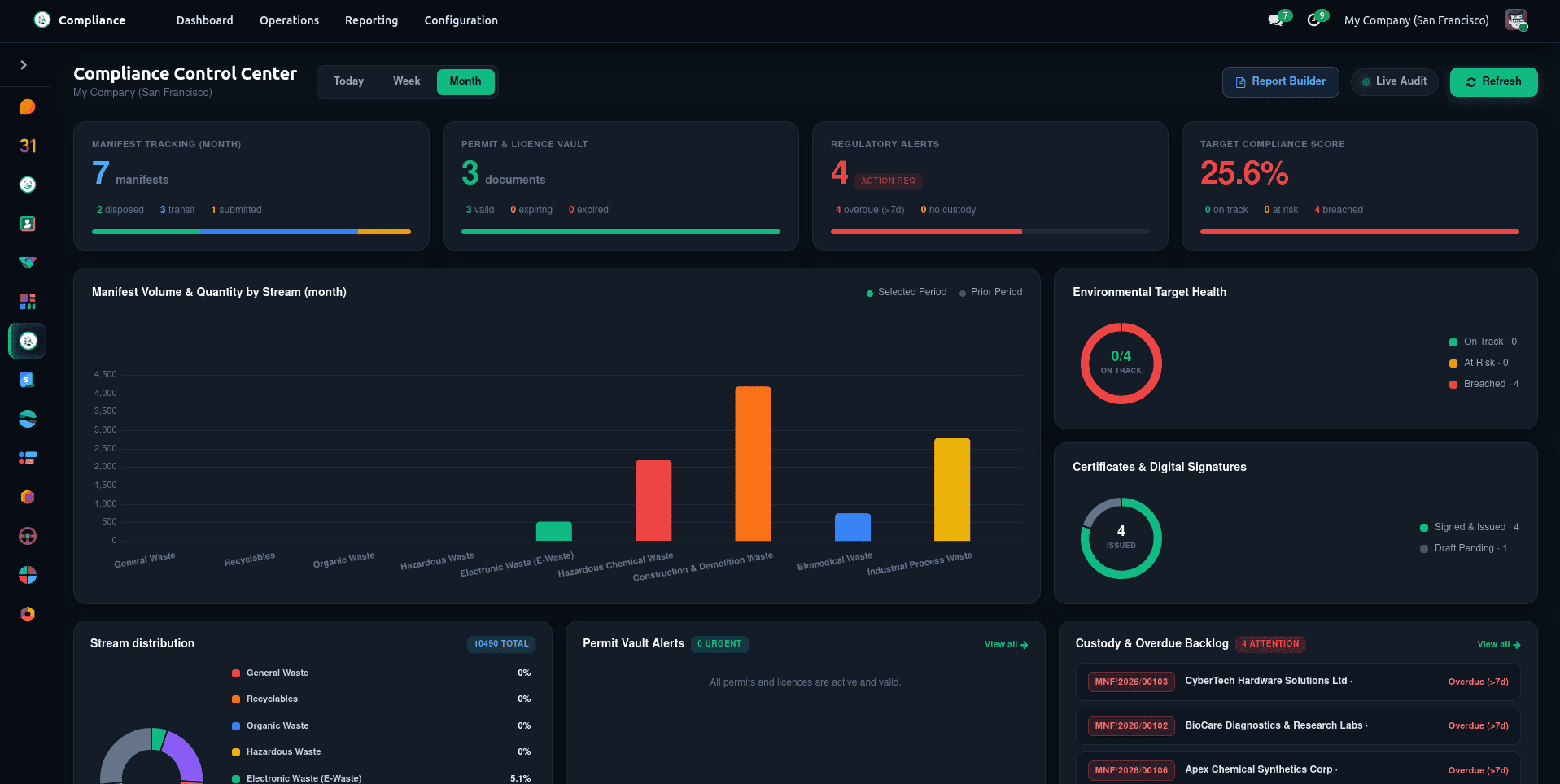
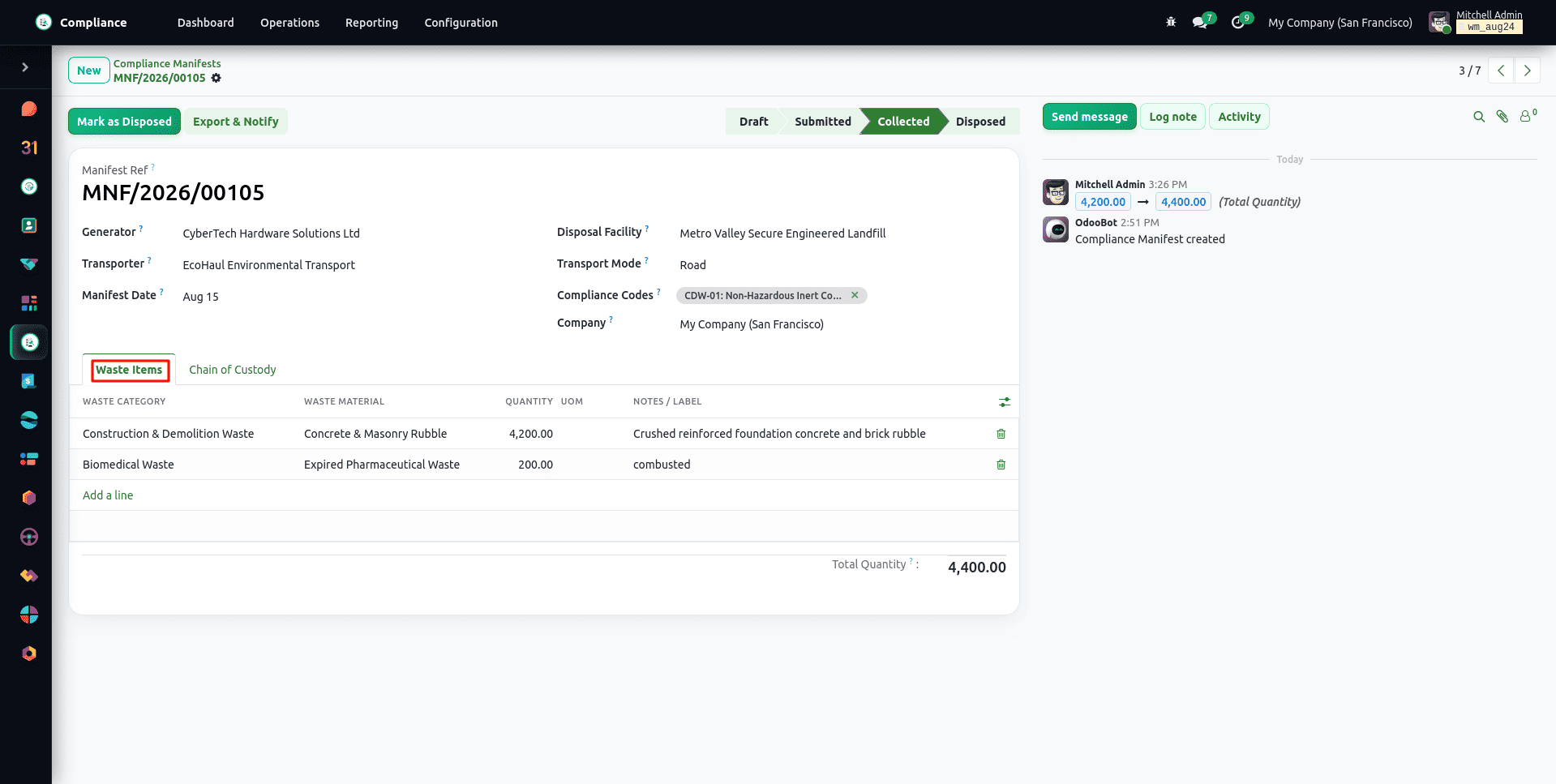
Together with the operations, the root of the Compliance application maintains a legal record of the documents required by environmental authorities. The Compliance Manifest (under Compliance > Operations > Manifests) lists the transport of hazardous waste from the Generator to the Transporter and then to the Licensed Disposal Facility.
The Manifest goes through Draft > Submitted > Collected > Disposed stages. As soon as the status is set to Disposed, the document becomes locked in the Python model forever, and no more changes are allowed. Every manifest has an immutable Chain of Custody record containing handlers along with timestamps and signatures.
Tamper-Evident Compliance Certificates
For every disposal or recycling consignment, the facility issues a Compliance Certificate (Compliance > Operations > Certificates) recorded as Disposal, Recycling, Treatment, or Destruction.
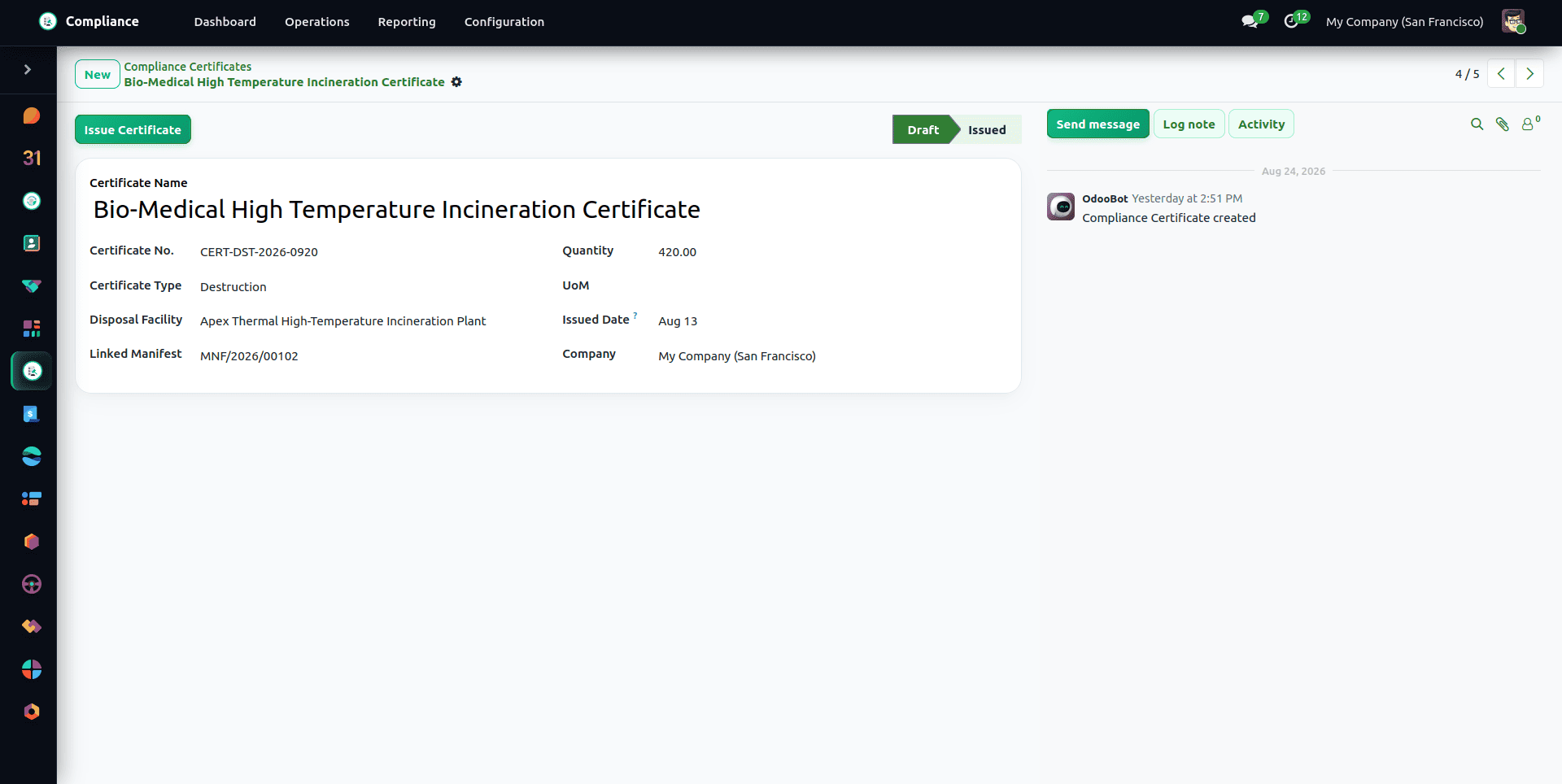
Clicking Issue on a certificate generates a signed PDF through the built-in digital signature engine, computes a cryptographic SHA-256 hash of the PDF for tamper detection, attaches the file to the record's chatter, and links the certificate back to the transport vehicle for ADR audit compliance.
Document Vault and Regulatory Quota Targets
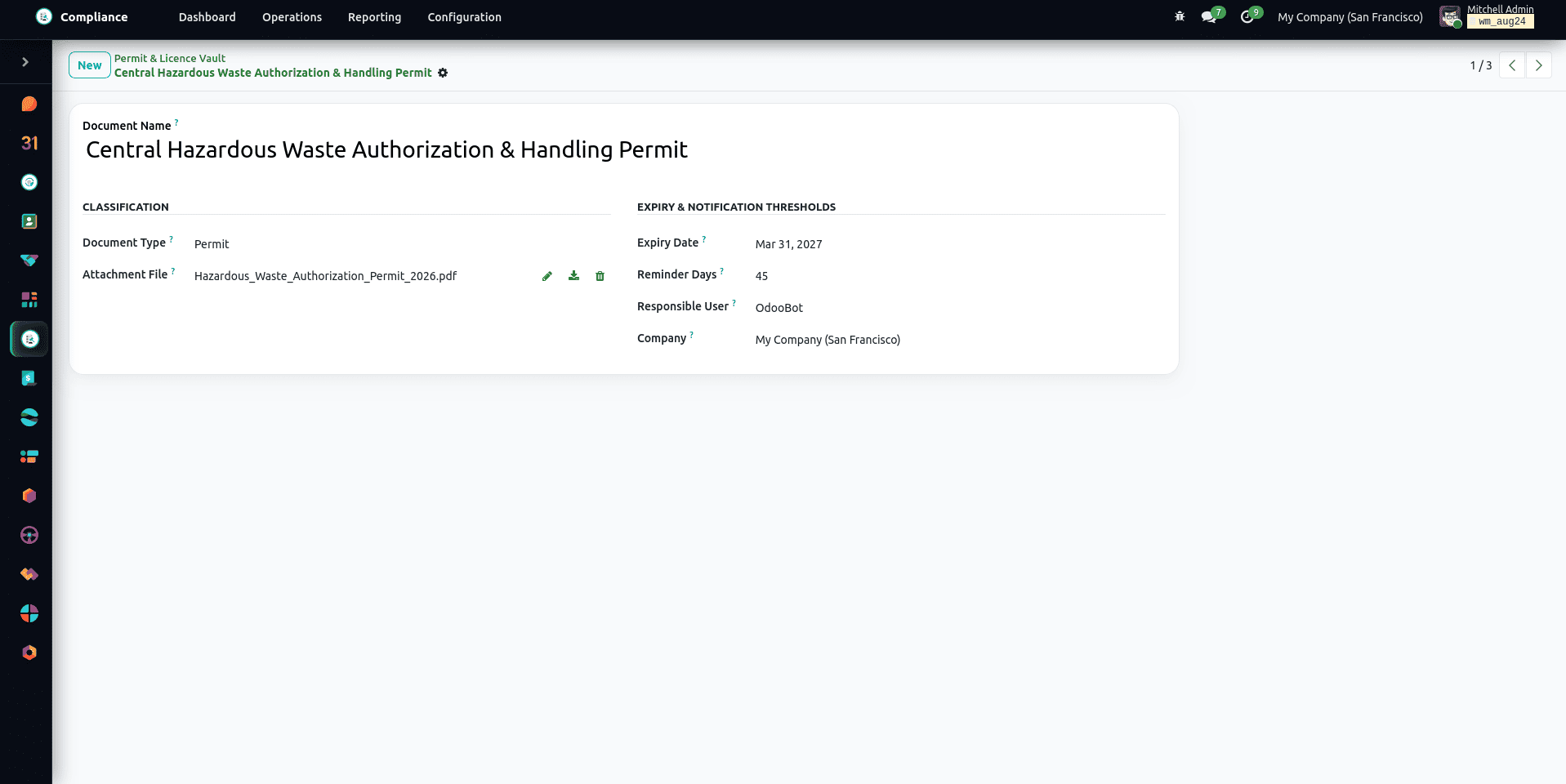
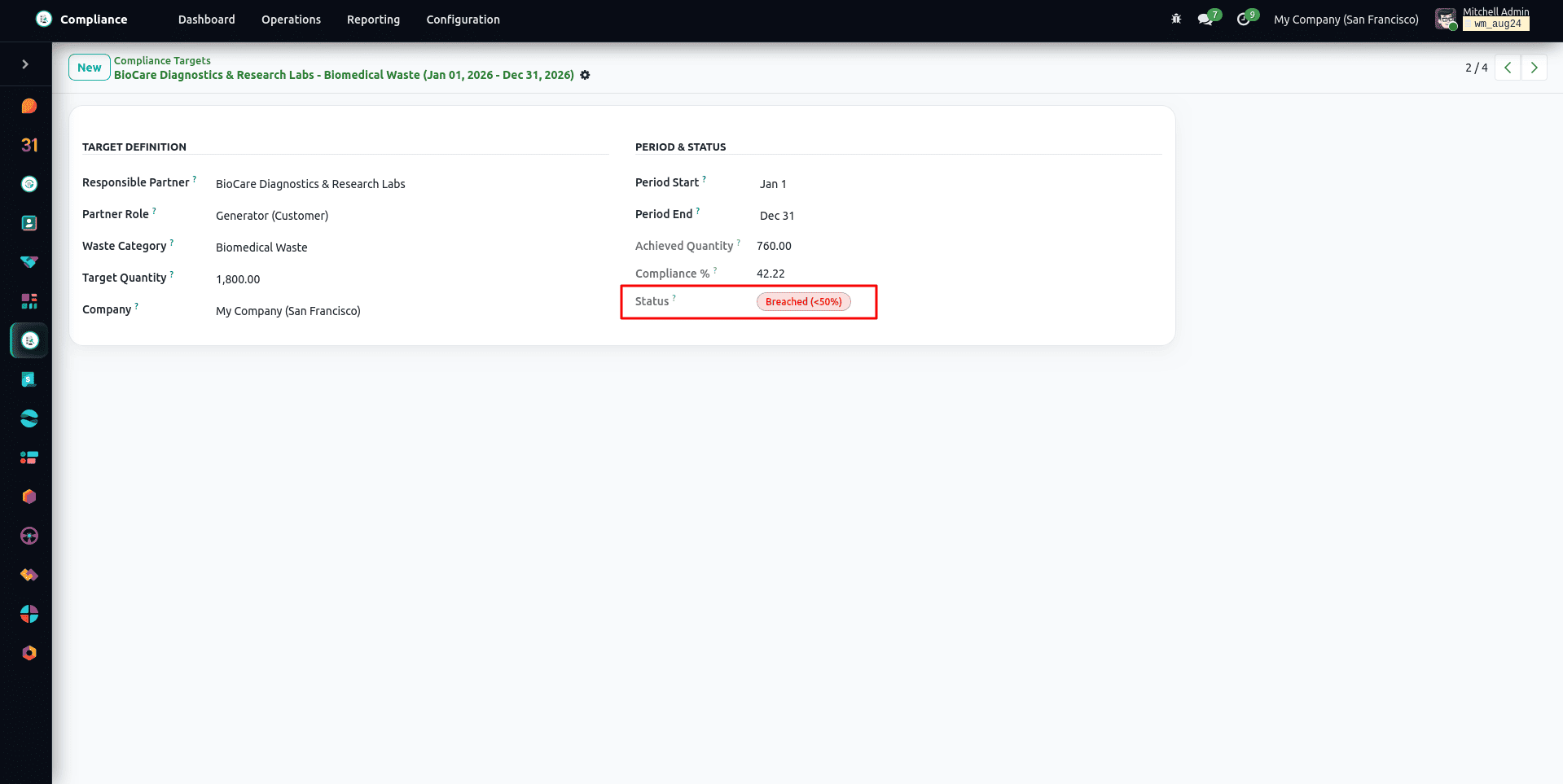
All regulatory licences, environmental permits, and audit reports are stored in a single central repository in the Document Vault (Compliance > Operations > Permits & Licences), and automated email warnings are sent out when licences expire. The regulatory diversion and recycling quotas are kept under review as part of the Compliance Targets.
Monthly Consolidated Billing Runs & Dynamic Pricing Rules
The invoice for the customer is prepared by the Monthly Billing Run, a feature located under Waste Management > Billing > Invoicing & Runs > Monthly Billing Runs, which brings all the completed collection orders for the period together into a single itemized invoice.
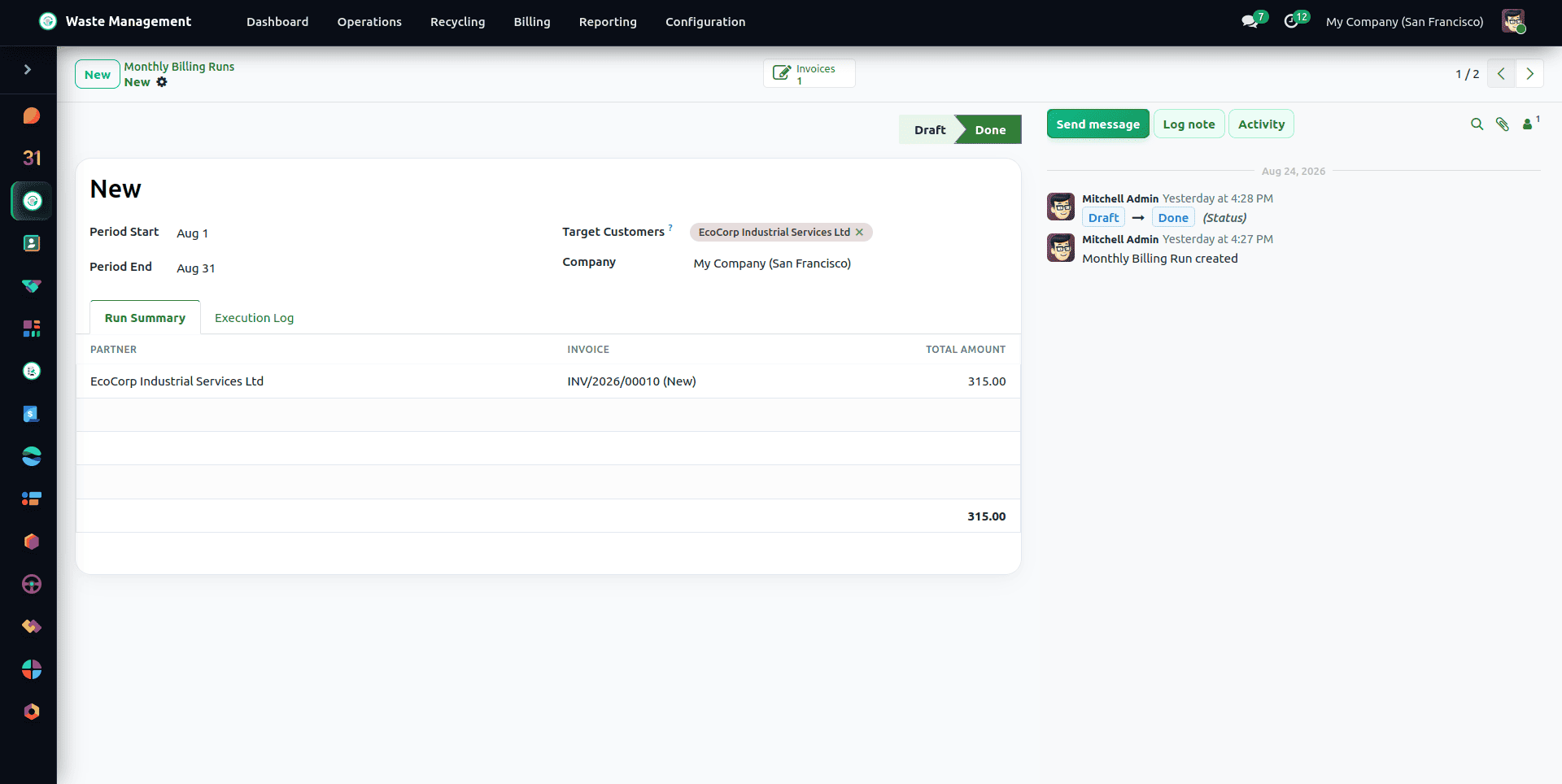
Running it is a streamlined sequence: select the billing period, optionally filter specific customers, and click Run Billing. The system aggregates actual pickup weights, applies contract rate cards, includes minimum stop charges and overweight surcharges, and generates consolidated draft invoices in Odoo Accounting.
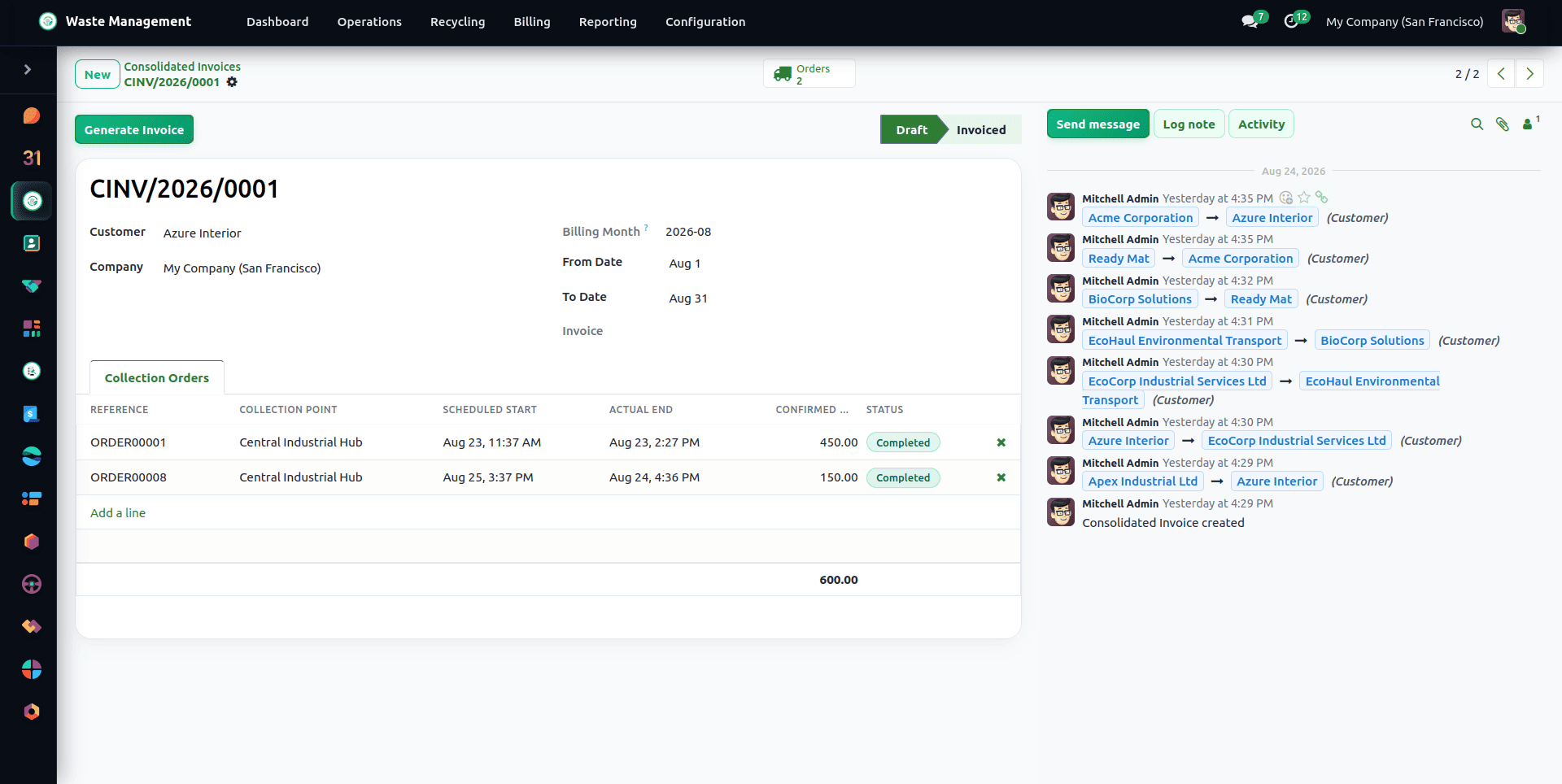
The pricing rules (in the section Waste Management > Billing > Pricing Rules) include provisions for rate overrides in certain cases, such as when charging surcharges for hazardous materials, making seasonal adjustments, or giving volume discounts to customers who use large volumes. Financial reports - for example, Revenue Analysis, Customer Profitability & Overage, and Weight-to-Revenue Correlation - allow the finance team to continuously monitor how billing performance stacks up against operational transport costs.
Electronic Signatures, OWL Dashboard & Immutable Audit Trail
The Electronic Signature module can be used with field pickups, compliance manifests, and disposal certificates (in Waste Management > Configuration > Signature Templates). Signature Template – This section is where you set up different user signing chains (for example, Driver > Site Contact > Operations Manager). When a document has to be signed, the users are provided with a secure link on which they log in, view the document, sign it (using touchscreen signing on their mobile device), and then submit it to the system, which subsequently imprints the signature, generates the SHA-256 signature, and logs the verification in the chatter.
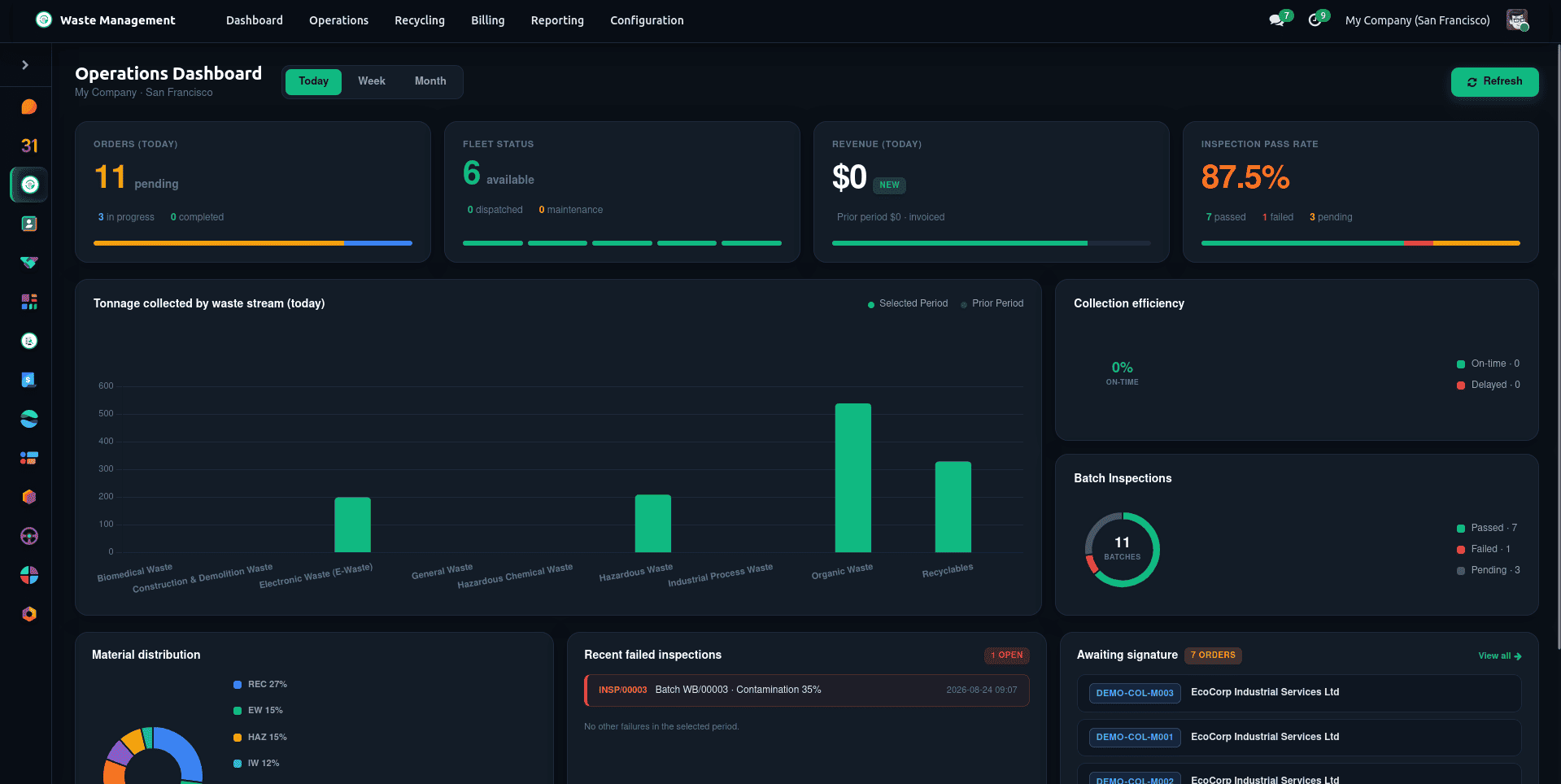
The information referred to is available in the relevant Executive Dashboard (Waste Management > Dashboard), a component of OWL that has been constructed to be reactive and which shows the key performance indicators (today's collection, the current routes, the yard batch backlog and the monthly diversion rate) in real time, there being no need to reload the page.
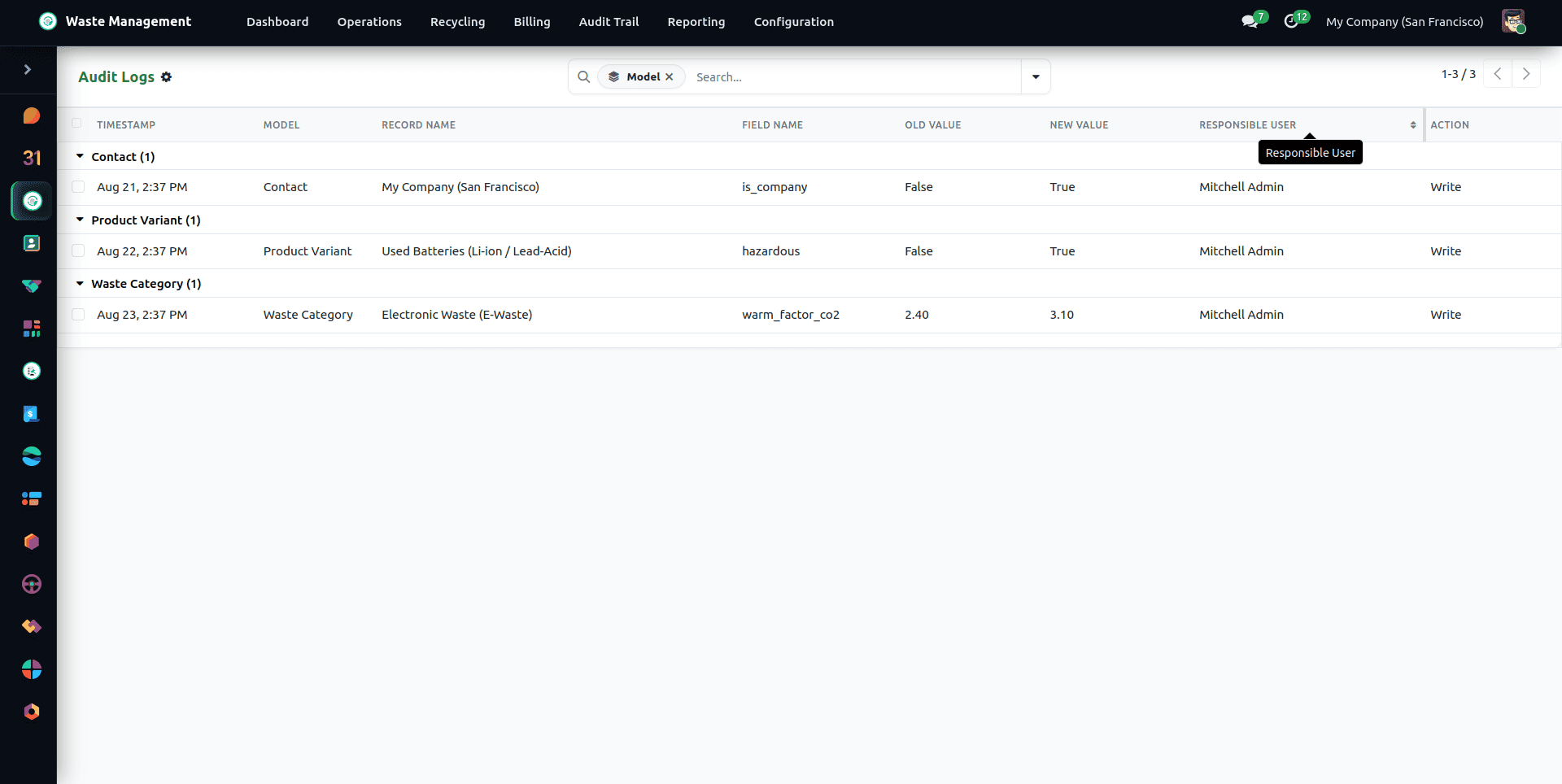
Every create, write, and delete on a Waste Management record is captured in the Audit Log under Waste Management > Audit Trail > Audit Logs, which is strictly immutable – records cannot be deleted or modified, even by the Administrator.
A Fully Integrated Waste Management Suite
The Waste Management ERP suite brings together five cohesive modules into a unified solution for modern waste operations:
- Waste management Base: contains the waste categories, the types of containers, the digital signature workflows, and the executive OWL dashboard.
- Waste Management Collection (Collection & Logistics): looks after geolocated collection points, carries out optimisation of TSP routes, provides vehicle safety checklists, and handles intake at the weighbridge.
- Waste management Compliance: Ensures that statutory manifests are followed, maintains an unchangeable chain of custody, uses SHA-256 certificates, and guards the permit vaults.
- Waste management Recycling: Monitors the MRF recovery orders, the yield percentages, the automated sales orders, and the EPA WARM Scope 3 carbon accounting.
- Waste management Contracts & Billing: Deals with commercial contracts, dynamic pricing rules, SLA tracking, the customer portal, and the monthly billing runs.
To read more about How to Configure and Use the Odoo Jira Connector in Odoo 18, refer to our blog How to Configure and Use the Odoo Jira Connector in Odoo 18.