Types of Accounting in Odoo 19
Odoo 19 focuses mostly on two types of accounting operations. "Anglo-Saxon accounting" and "Continental accounting" are the two categories of accounting. There are some changes in Odoo 19 Accounting. The Anglo Saxon Accounting will work only if the Inventory Valuation is set as Perpetual (at invoicing). To get the Continental Accounting, the Inventory valuation should be set as Periodic (at closing).
Continental Accounting (Periodic (at closing))
The Odoo system, Odoo19, and Continental accounting�the most popular accounting technique�strongly support these ideas. This accounting method is supported by both the Enterprise and Community editions of Odoo 19. When a purchase is made, this accounting will have an impact on the expense account. As a result, as soon as a product is found to be in stock, its cost is taken into account. Continental accounting is used by default on the Odoo19 platform.
To get to this, click on the Accounting Settings. Choose the Inventory Valuation as Periodic (at closing).
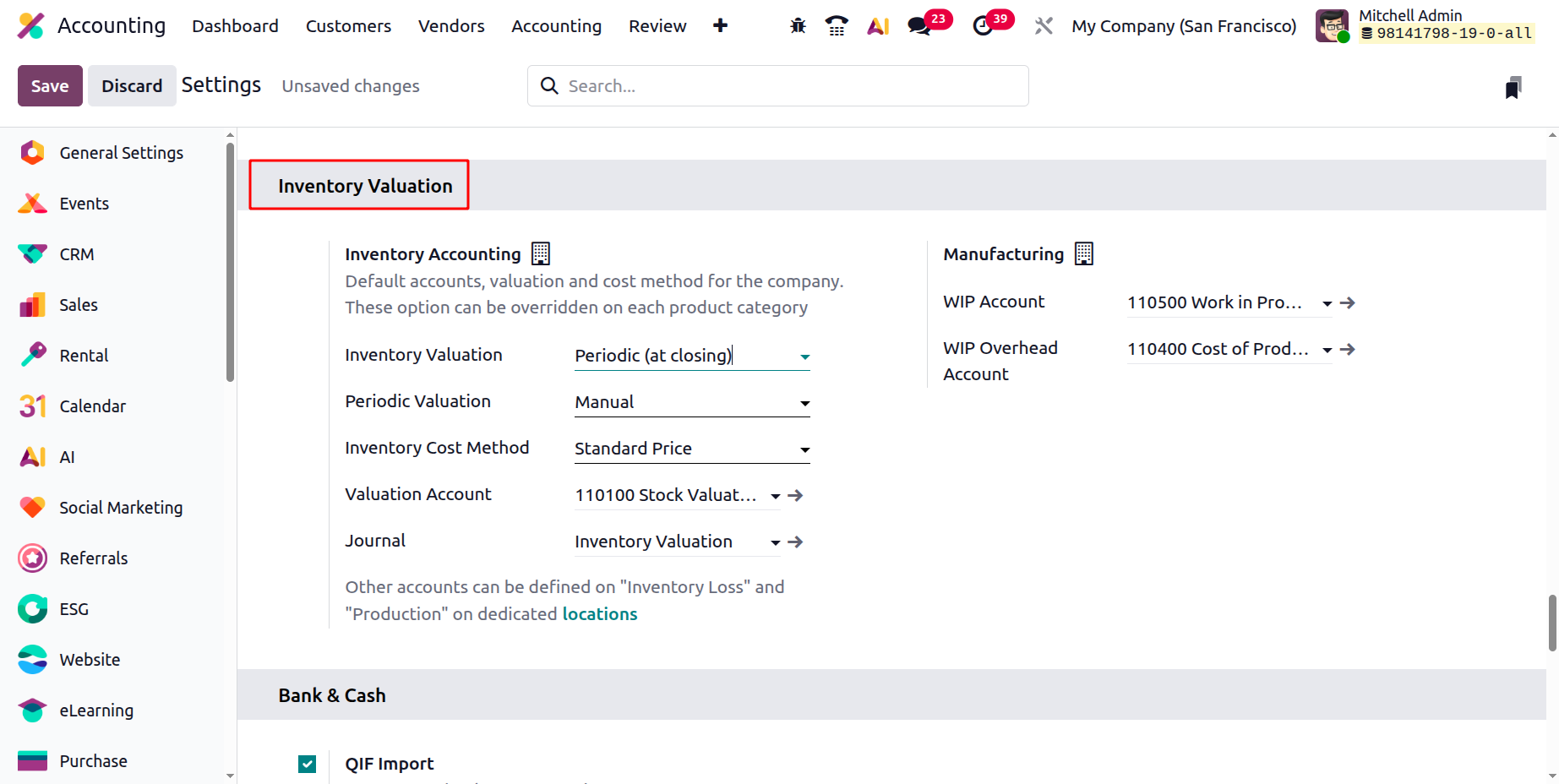
The long history of Continental accounting benefits your company's accounting in a number of ways. Consequently, we might examine how the ledgers impact various accounting transactions or procedures.
Transactions in Continental Accounting
Any financial activity that directly impacts a company's financial standing and financial statements is considered an accounting transaction. All financial transactions can be categorized under this area, in principle. These transactions are handled differently by different companies or organizations. In order to study some of the fundamental accounting transactions.
1. Purchase Process
Purchases are the financial transactions necessary for the business to get the goods or services needed to generate income. On the Odoo19 platform, "Purchase Journals" refers to all transactions pertaining to purchases. The purchase voucher contains records of all these transactions pertaining to purchases. It is the transaction overseen by the vendor of a purchased good or service, though it could also be any other asset. The buy order, material receipt, rejection out, purchase invoice, and purchase return are only a few of the transactions that make up a purchase.
-
Purchase Order: In a formal document called a purchase order, a buyer commits to paying a seller for the sale of a specific good or service that will be rendered at a later time. Any goods or services can be purchased for the required amount from a vendor using a purchase order. When a purchase order is started, the stock and account ledgers are not immediately affected.
-
Goods Receipt: Information concerning the products intended for the workers' on-site operations, such as product quantities and lot numbers, is handled by the subsequent procedure, called reception. The product has to be received and added to the inventory if it is provided by the supplier. The inventory will be updated with the quantities. Therefore, only the stock accounts are impacted by Material Receipts.
-
Rejection Out (Purchase Return): The business frequently returns the goods it has purchased, even before payment is received. It might be for any number of reasons. The product will be rejected if it is damaged. Numerous factors will also affect the rejection. Consequently, the stock will reverse. To the same stock accounts, it will be reversed. The stock value will consequently drop as well.
-
Purchase Bill Creation: The payable and expenditure accounts will be impacted if you create a bill for the purchase order. Since the payable account is a "Liability," credit will be given to it. However, because it is an "expense" account, the expenditure account is debited.
| Accounts |
Nature |
Increasing Or
Decreasing |
Credit Or Debit |
| Account Payable |
Liability |
Increasing |
Credit |
| Expense Account |
Expense |
Increasing |
Debit |
-
Registering Payment: The payable account and the outstanding receipt account are both affected when a payment is issued. The responsibility will be reduced if the payment has been made. The payable account will be debited as a result. In the bank and cash journals of Odoo 19, unreconciled inputs are stored in a temporary account called outstanding payments. "Liability" is the category of unpaid bills. Alternatively, it might be set up as an "Asset." Both setups are accurate. Asset = -Liability. Consequently, the overdue payment account is credited when the responsibility for outstanding accounts rises.
| Accounts |
Nature |
Increasing Or
Decreasing |
Credit Or Debit |
| Accounts payable |
Liability |
Decreasing |
Debit |
| Outstanding Payments |
Liability |
Increasing |
Credit |
-
Reconciling: The money will be taken out of the bank account after it has been matched or reconciled with the bank statement. As a result, the account for outstanding accounts is debited, and the bank is credited.
| Accounts |
Nature |
Increasing Or
Decreasing |
Credit Or Debit |
| Outstanding Payments |
Liability |
Decreasing |
Debit |
| Bank Account |
Asset |
Decreasing |
Credit |
A "purchase return" occurs when a customer returns an item to a seller for a refund or for any other reason based on the seller's responsibility. Occasionally, purchases will be returned because of product damage or quality problems.
For instance, if the business is dissatisfied with the product, if they accidentally purchased it, if the vendor received the incorrect item, or even if the business receives more items than they ordered. The stock is subtracted, and the entire amount paid must be repaid because a return occurs after the invoice payment. Consequently, both the accounts and the stock accounts will be impacted by the purchase return. Reverse journal entries should be produced appropriately to make up for this.
The table below provides specific journal entries for every purchasing transaction.
| Operation |
Accounts Affected |
Debit |
Credit |
| Purchase Bill |
Expense Account |
XX |
|
|
Account Payable |
|
XX |
| Registering Payment |
Account Payable |
XX |
|
|
Outstanding Payments |
|
XX |
| Reconciling |
Outstanding Payments |
XX |
|
|
Bank Account |
|
XX |
1. Sales Process
A sales transaction is any agreement, sale, or other transfer that involves the delivery of goods, services, or other assets, both tangible and intangible. Here, we might talk about how the Odoo19 platform could help you manage sales transactions, the procedures that go along with them, and how they affect journal entries. Sales orders, delivery notes, rejection INs (sales returns), sales invoices, and invoice payment are all included in a sales transaction. The following sales transaction operations could be our starting point.
-
Sales Order: A sales order is essentially a document created by the business to gather details about the goods or services that the customer has placed an order for. The sales order contains information on the goods or service, the price, the quantity, the terms and conditions, and many other data. The selling order is solely intended to be used for order generation because it has no effect on inventories or accounts.
-
Delivery Note: A delivery note is a document pertaining to the transportation or delivery of goods. We'll go over the specifics of the products, including their amount and cost. The Dispatch Note and the Goods Reception Note are other names for the Delivery Note. The stock value drops when a confirmed order is filled from the inventory and sent to the customer.
-
Rejection IN (Sales Return): Even after an item has been billed and paid for, customers regularly return it. Accounts and inventory are adjusted as a result of this kind of sales return. They will also have diary entries produced for them in reverse. One very helpful tool for keeping track of the goods that customers have rejected or returned is a Rejection IN. If the products are returned prior to billing, only the stock will be affected; the accounts won't be affected. The stock value rises when the product is put back into stock.
-
Sales Invoice Creation: A sales invoice is a type of accounting document that a business that provides goods or services delivers to a client. Everything will be covered, including the given goods and services, the price to the client, the mode of payment, and more. It is necessary for more significant transactions and is a legally binding agreement between the company and its customers. Both the Income Account and the Receivables Account will be impacted by this. Examining these accounts' attributes reveals that the Income Account is "Income," while the Accounts Receivable is "Asset." Since the quantity to be received from clients is rising in this instance, the asset is growing. When a sale occurs, the revenue also rises. As a result, the Income Account is debited and the Accounts Receivable is credited.
| Accounts |
Nature |
Increasing Or
Decreasing |
Credit Or Debit |
| Income Account |
Income |
Increasing |
Credit |
| Account Receivable |
Asset |
Increasing |
Debit |
-
Registering Payment: A temporary account called Outstanding Receipts is used to register payments. Payment registration results in the creation of a journal item containing Accounts Receivable and Outstanding Receipts.
| Accounts |
Nature |
Increasing Or
Decreasing |
Credit Or Debit |
| Accounts Receivable |
Asset |
Decreasing |
Credit |
| Outstanding Receipts |
Asset |
Increasing |
Debit |
-
Reconciliation: The money will be deposited into the bank account after reconciliation and comparison with the bank statement. As a result, the bank is debited, and the account for unpaid receipts is credited.
| Accounts |
Nature |
Increasing Or
Decreasing |
Credit Or Debit |
| Outstanding Receipts |
Asset |
Decreasing |
Credit |
| Bank account |
Asset |
Increasing |
Debit |
The journal entries for every sales transaction are broken out in the table below.
| Operation |
Accounts Affected |
Debit |
Credit |
| Customer Invoice |
Income Account |
|
XX |
| Account Receivable |
XX |
|
| Registering Payment |
Accounts Receivable |
|
XX |
| Outstanding Receipts |
XX |
|
| Reconciling |
Outstanding Receipts |
|
XX |
| Bank Account |
XX |
|
When using the double-entry bookkeeping technique, the total of the debits and credits will ultimately match.
Anglo-Saxon Accounting (Perpetual (at invoicing))
Small areas, such as those in the US, UK, Ireland, Canada, Australia, and many other nations, are suitable for Anglo-Saxon accounting. Only the Odoo enterprise edition offers Anglo-Saxon accounting. There are numerous distinctions between the Anglo-Saxon and Continental accounting systems. We spoke about how a purchase affects the expenditure account of Continental Accounting. However, in Anglo-Saxon accounting, the execution of a sales order and the validation of the invoice have an impact on the expenditure account.
You must set the Inventory Valuation to Perpetual (at invoicing) in the Odoo 19 Accounting Configuration Settings, if you wish to utilize all of Odoo Accounting's features.
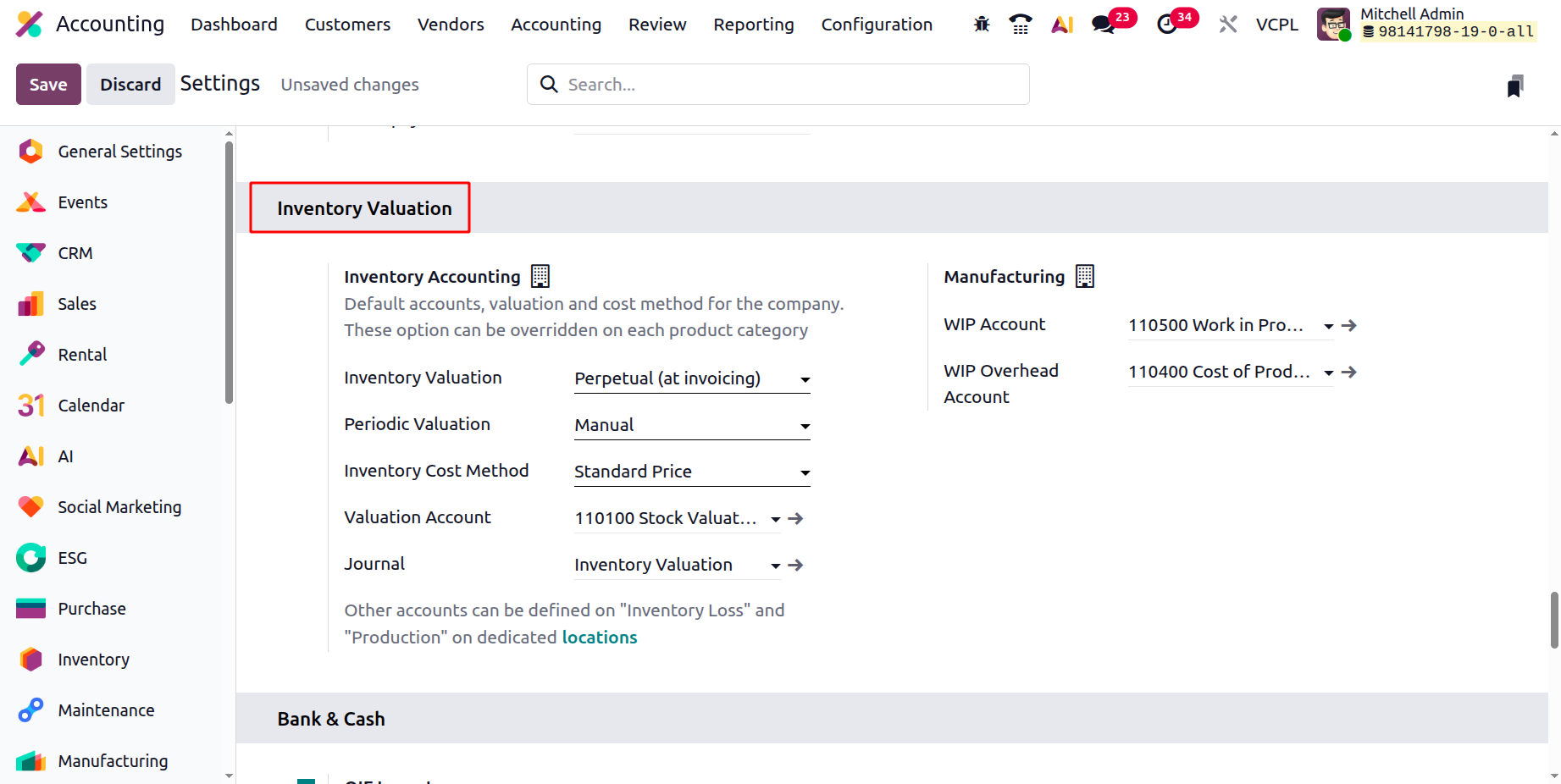
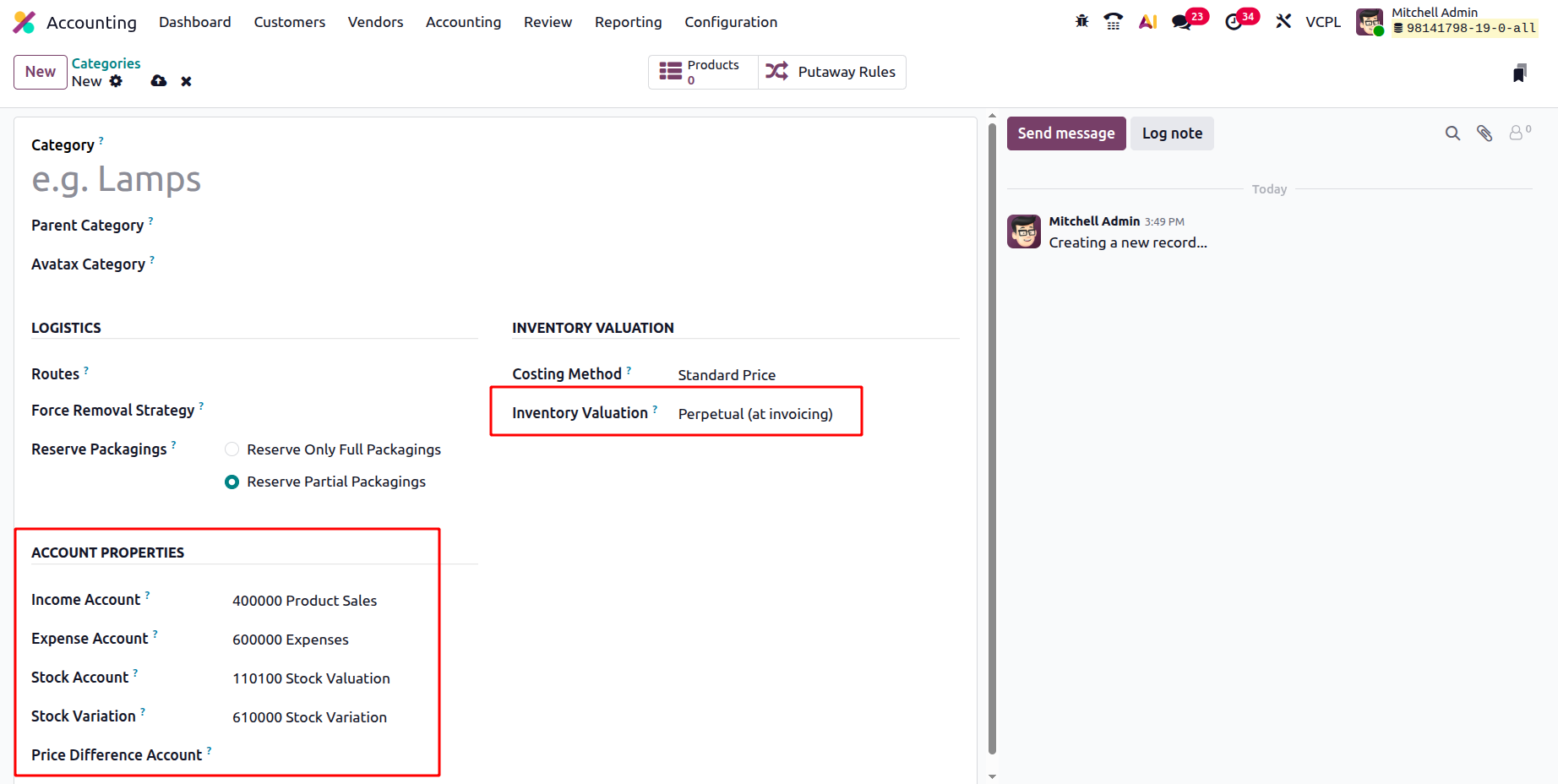
The "Price Difference" account, which documents the discrepancy between the purchase price and the vendor bill, is another important aspect of the Anglo-Saxon accounting system. Additionally, the stock account features can be recorded by marking the inventory valuation as Perpetual (at invoicing).
Transactions in Anglo-Saxon Accounting
1. Purchase Process
An expense may occasionally go unrecorded after it is incurred. Large-scale purchases could be made and dispersed over time. Therefore, including them as a cost in financial entries will have a greater impact on the company's profit and loss. Therefore, it is usual practice to record purchased commodities as assets and expenses at the time of consumption or sales in order to handle those scenarios. The ledgers contain records of asset costs.
We'll start by making a purchase.
-
Purchase Order: Purchase orders have no bearing on any accounting ledgers; they merely offer a valid document for obtaining products or services from the vendor.
-
Purchase Receipt: Once the products have been received and acknowledged, the incoming assets must be added to stock. As a result, stock has an impact on both stock valuation and stock input accounts.
-
Purchase Return: If a product has a flaw or is damaged, you may occasionally be able to return the item you purchased. As a result, stock accounts are flipped, and the stock move is exactly the opposite of the incoming one.
-
Purchase Bill: The purchase bill is posted following the completion of the purchase receipt. As previously stated, rather than at the time of purchase, the direct cost will be recorded in Anglo-Saxon as an asset. As a result, after a bill is generated, "Account Payable" and "Stock interim accounts" are impacted. The amount owed to the vendor is in Accounts Payable. As a result, when a bill is created, the amount owed to the vendor rises, increasing the company's responsibility and crediting the Accounts Payable.
| Accounts |
Nature |
Increasing Or
Decreasing |
Credit Or Debit |
| Account Payable |
Liability |
Increasing |
Credit |
| Tax Account |
Asset |
Increasing |
Debit |
| Stock Input account |
Asset |
Increasing |
Debit |
-
Register Payment: This entails sending funds to the seller or completing a payment. This has an impact on "Account Payable" and "Outstanding Payment Accounts." The payments paid to the vendor reduce the company's current liability. The company's payable obligations are documented in accounts payable. As a result, Accounts Payable, which is by definition a liability, gets debited when the liability declines. Unreconciled outgoing payments are held in the Outstanding Payment account, which serves as a middleman. These overdue payment accounts are utilised to reconcile with the bank statement instead of the accounts payable. Consequently, the "Outstanding Payments" account gets credited each time a payment is logged.
| Accounts |
Nature |
Increasing Or
Decreasing |
Credit Or Debit |
| Accounts Payable |
Liability |
Decreasing |
Debit |
| Outstanding Payments |
Liability |
Increasing |
Credit |
-
Reconciliation: The next stage is for the vendor payment and bank statement to coincide. Reconciliation thus affects the "Outstanding Payment" and "Bank" accounts. The vendor payment and the bank statement must match in order to proceed. Thus, the "Bank" and "Outstanding Payment" accounts are impacted by reconciliation. During this process, it will be noted that the vendor has finally been paid by the bank account. As a result, the asset in "Bank" diminishes, crediting "Bank," and the liability in "Outstanding Payment" reduces, debiting "Outstanding Payment."
| Accounts |
Nature |
Increasing Or
Decreasing |
Credit Or Debit |
| Outstanding Payments |
Liability |
Decreasing |
Debit |
| Bank Account |
Asset |
Decreasing |
Credit |
The table below displays the total number of journal entries made during the purchasing procedure.
| Operation |
Accounts Affected |
Debit |
Credit |
| Purchase order |
No Accounts Affected |
|
|
| Purchase Bill |
Stock Input Account |
XX |
|
| Account Payable |
|
XX |
| Registering Payment |
Account Payable |
XX |
|
| Outstanding Payments |
|
XX |
| Reconciling |
Outstanding Payments |
XX |
|
| Bank Account |
|
XX |
2. Sales Process
Order placement, product delivery to the customer, invoice creation, payment, and reconciliation are just a few of the stages involved in a sales transaction.
-
Sale Order: A sales order is generated when a customer details the goods and services they need, the quantity they need, the confirmed pricing, etc. There is no effect on any of the accounts.
-
Delivery Note: After an order is accepted, the customer must receive the items. The features of the stock account will change after delivery has been confirmed.
-
Sales Return: Let's say a customer returns anything for any reason. This is also how the stock is flipped.
-
Sales Invoice: When generating a sales invoice for a customer, the "Income Account" and the "Account Receivable" are affected. While "Account Receivable" refers to assets, "Income Account" refers to revenue. As a result, when assets and income rise, the "Income Account" is credited and the "Account Receivable" is debited. Also, two other ledgers�the "Expense" Account and the "Stock Output Account"�are also affected because, according to Anglo-Saxon accounting, the expense is impacted as soon as the bought item is sold out or depleted.
| Accounts |
Nature |
Increasing Or
Decreasing |
Credit Or Debit |
| Income Account |
Income |
Increasing |
Credit |
| Account Receivable |
Asset |
Increasing |
Debit |
| Tax Account |
Liability |
Increasing |
Credit |
| Stock Output Account |
Expenses |
Decreasing |
Credit |
| Expense Account |
Expenses |
Increasing |
Debit |
-
Payment Registering: The "Account Receivable" and "Outstanding Receipts" accounts are impacted once a customer pays and registers in Odoo 19. The amount that has to be recovered from the customer is recorded in the accounts receivable. "Account Receivable" is an asset by definition. As the client makes payments, assets are credited and decreased. Prior to being reconciled with the "Bank," the incoming cash was first briefly kept in the "Outstanding Receipts" account. When the value of the assets rises, the Outstanding Receipts account is debited.
| Accounts |
Nature |
Increasing Or
Decreasing |
Credit Or Debit |
| Accounts Receivable |
Asset |
Decreasing |
Credit |
| Outstanding Receipts |
Asset |
Increasing |
Debit |
-
Reconciliation: When a payment is compared to a bank statement, the bank is debited, increasing the asset in the bank. Additionally, the parallel outstanding receipts account is used to credit and decrease assets.
| Accounts |
Nature |
Increasing Or
Decreasing |
Credit Or Debit |
| Outstanding Receipts |
Asset |
Decreasing |
Credit |
| Bank account |
Asset |
Increasing |
Debit |
-
Sales Return: Returned items affect stock, and if the invoice has already been paid, a credit note for the reimbursement must be given.
The complete journal entry is listed below.
| Operation |
Accounts Affected |
Debit |
Credit |
| Customer Invoice |
Income Account |
|
XX |
| Account Receivable |
XX |
|
| Tax Account |
XX |
|
| Stock Output Account |
XX |
|
| Expense Account |
|
XX |
| Registering Payment |
Accounts Receivable |
|
XX |
| Outstanding Receipts |
XX |
|
| Reconciling |
Outstanding Receipts |
|
XX |
| Bank Account |
XX |
|