Inventory Valuation
In Odoo 19, inventory valuation can be configured using two methods:
- Perpetual Inventory Valuation
- Periodic Inventory Valuation
Both methods determine how inventory movements affect accounting records. The key difference lies in when the accounting entries are finalized. The following sections explain the workflow of both valuation methods.
Periodic Inventory Valuation
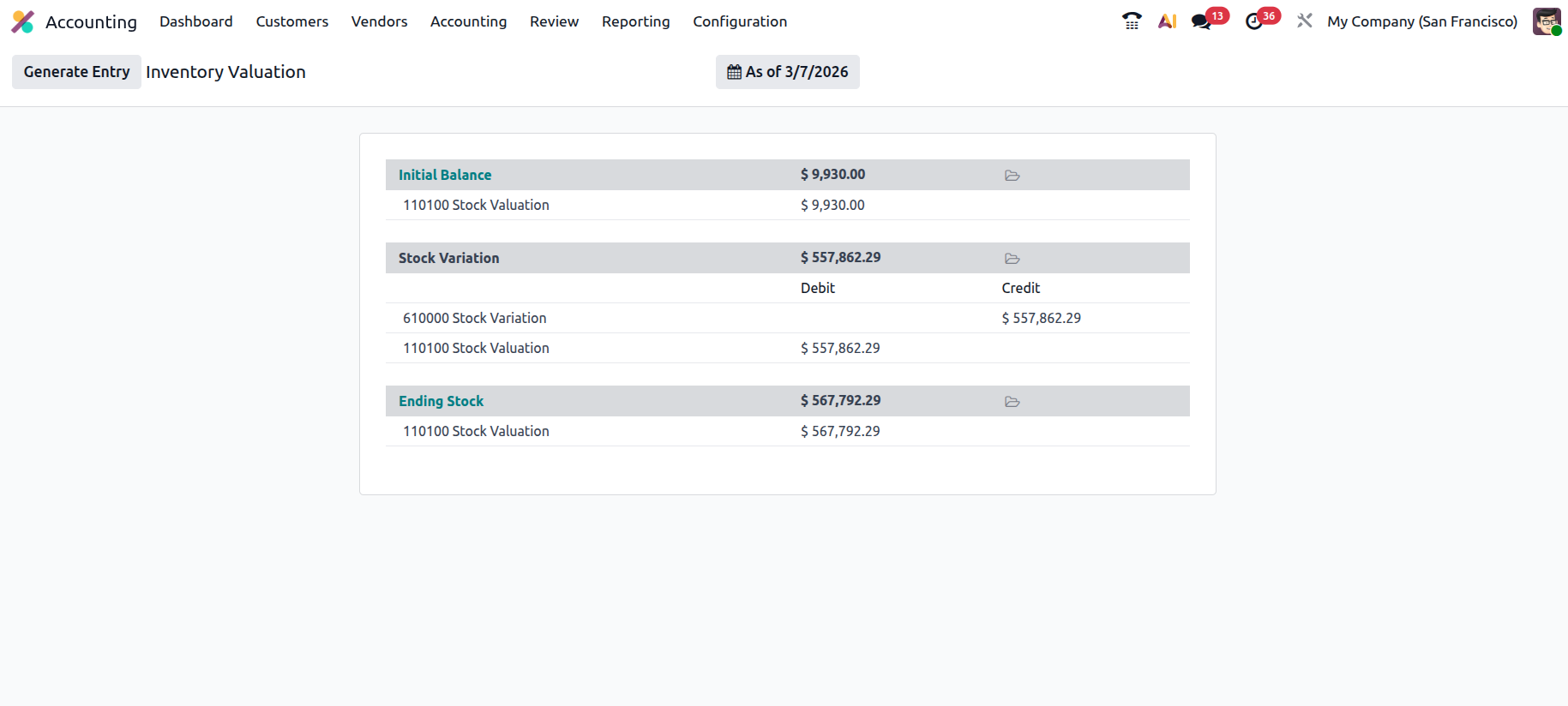
In Periodic Inventory Valuation, stock movements temporarily affect accounting through the Stock Valuation and Stock Variation accounts. The final accounting adjustment is generated manually from the Inventory Valuation Report.
The Inventory Valuation Report generally contains three main sections:
- Initial Balance
- Stock Variation
- Ending Stock
These sections together represent the opening inventory value, the changes during the period, and the closing inventory value.
Initial Balance
The Initial Balance represents the opening inventory value at the beginning of the reporting period. This value is carried forward from the previous accounting period and reflects the amount recorded in the Stock Valuation account.
Example:
| Account |
Amount |
| Stock Valuation |
$9,930.00 |
This indicates the value of inventory available at the start of the period.
Product Receipt (Purchase)
When a Purchase Order is confirmed and the products are received, the inventory value increases and the following accounting entry is recorded:
| Account |
Debit |
Credit |
| Stock Valuation |
XXX |
|
| Stock Variation |
|
XXX |
- The Stock Valuation account is debited because the inventory asset increases when goods are received.
- The Stock Variation account is credited to temporarily record the increase in inventory value.
At this stage:
- The Stock Variation section in the Inventory Valuation Report reflects the transaction value.
- The Ending Stock value increases according to the value of
received products.
Product Delivery (Sale)
When products are delivered to customers, the inventory value decreases and the following entry is recorded:
| Account |
Debit |
Credit |
| Stock Variation |
XXX |
|
| Stock Valuation |
|
XXX |
- The Stock Valuation account is credited because inventory is leaving the warehouse.
- The Stock Variation account is debited to record the temporary reduction in inventory value.
As a result:
- The Stock Variation section reflects the decrease in stock value.
- The Ending Stock value is reduced according to the value of the delivered products.
Ending Stock
The Ending Stock represents the total inventory value remaining at the end of the reporting period.
It is calculated as:
Ending Stock = Initial Balance + Stock Increases − Stock Decreases
This value represents the inventory currently available in the warehouse.
Generating the Adjustment Entry
In periodic valuation, the entries created from stock movements remain temporary until they are finalized.
The accountant must click the Generate Entry button in the Inventory Valuation Report. When this entry is generated and posted:
- The Stock Variation account is cleared.
- The temporary balances created by stock movements are removed.
- Inventory accounting for the period is finalized.
Perpetual Inventory Valuation
In Perpetual Inventory Valuation, inventory accounting is handled automatically in real time. The accounting entries are posted automatically when financial documents related to purchases or sales are created.
Product Receipt (Purchase)
When a Purchase Order is confirmed and the products are received, the inventory value increases and the following entry is created:
| Account |
Debit |
Credit |
| Stock Valuation |
XXX |
|
| Stock Variation |
|
XXX |
The Stock Valuation account is debited because inventory increases.
The Stock Variation account is credited to temporarily record the value of the received goods.
Vendor Bill Creation
When the Vendor Bill for the purchase order is created:
- The accounting entries are automatically posted in real time.
- The Stock Variation account is cleared.
This ensures that the inventory valuation and accounting records remain synchronized.
Product Delivery (Sale)
When products are delivered to customers, the inventory value decreases and the following entry is recorded:
| Account |
Debit |
Credit |
| Stock Variation |
XXX |
|
| Stock Valuation |
|
XXX |
The Stock Valuation account is credited because inventory leaves the warehouse.
The Stock Variation account is debited to record the temporary reduction in inventory value.
Customer Invoice Creation
When the Customer Invoice is created:
- The accounting entries are automatically posted.
- The Stock Variation account is cleared.
This records the cost of the delivered products in the accounting system.